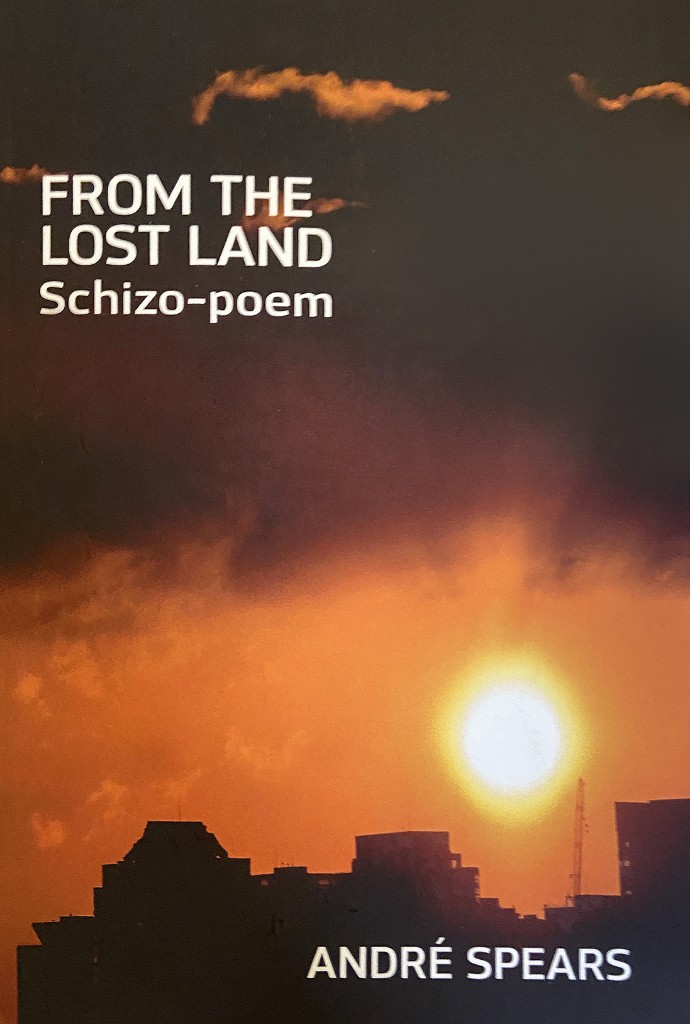
From the Lost Land: Schizo-poem by André Spears. 512 pp. Station Hill Press, 2025. $37.00.
for Andre
About a month after I received Andre Spears’ book, From the Lost Land: Schizo-poem, on the Feast of the Three Kings—as it became increasingly evident to me that it would take me a lifetime to truly read it (this being the highest praise I can give any book, for, paradoxically, I doubt I have ever read—finished reading—any book I truly love—can one have read an angel? One lives with, lives by, attends to, listens, loses, finds—I have yet to read The Four Zoas, Moby-Dick, Finnegans Wake, The Maximus Poems…)—I decided I should attempt responding to it “in midstream,” on the fly, as I go, as I try to swim along. I also thought I may have to do it in a spirit rather unprofessional and uncomely for our highly sanitized, strictured and structured, shackled mental moment in eternity.
So I thought I may, as is wont, begin by what I do not know, what I merely wonder:
- Is this the last possible epic where the middle pillar is still missing? And should what I write in response to it be as long as it—placed, squeezed in the middle? (Curious: we humans have developed a literary culture of marginal notation—aren’t most poems really that? But what’s the word for writing down the vacant middle? A McClure poem might be that.)
- Is this a death poem for the bicameral mind? The statement in extremis on this curious thing “we” as a civilization came up with, and took quite seriously, and believed in fiercely—a printed poem? Long before paper, long before print, long before carving, weren’t poems written on air, on water? Keats’ name was one such poem. And Shelley’s—on the wind.
- Are these, then, the marginal scribblings to such missing text, the anterior poem, the unsayable? Marginal notes to Silence.
At the centre of the poem are a couple, the lovers, named by each other A. and S.—which makes the initials of the author’s name. Or 4) does A.S. stand for Around Silence?
- Why letters? Why a pair? And what, then, is the empty space at the centre of each page? The child “we” lost? And is the sound of one hand clapping a palm pressed against one’s heart?
Having asked these, here then is something I think I can say about the poem itself: I think it is a long poem—possibly the single literary form that America uniquely invented, one that nobody outside America has ever quite attempted—but what is it, this American Long Poem thing? The poem that runs along the poet’s life? The poem including history? The poem including a dance around quotations, around what was written, spoken, overheard? The poem including letters? The poem as a mytho-goofy narrative of the seemingly spontaneous going on? Spears’ poem is all of these—but there is one thing that many American long poems were and this one is not: unfinished, unfinishable except by the poet’s death. Andre Spears is alive, and his poem is finished.
But that would be based on a lack of evidence. The Maximus Poems and The Cantos are such poems, but Paterson, A, or Gunslinger are not. Based on another lack of evidence I may assume that there are two types of American long poem—ones that open the door and others that close it. The ones that do not, will not, cannot get finished—the poet’s death stops it, as his life propelled it—are the ones that open doors; while the ones that get finished, thus include that terminal choice, are the ones that close the door. Generally speaking, this is bullshit, but somewhat interesting in the case of Spears’ poem, as I think it is a poem that closes the door. Only silence after it. I do not think anyone will or should ever imitate it, try to write something like it or in its vein—the way there are infinities of poetries in the vein of The Maximus Poems or The Cantos—they are made so as to make you try to go on, or else they are not made at all. An “unmade business,” he said.
This is indeed interesting to me, because I do think that one tremendous, monumental thing has been accomplished by From the Lost Land: the poet therein found a form, monolithic in its dedication to itself, or rather fiery in its fiery delight with itself—an active, effective, actual form—which is a very, very rare thing—very rarely does a poet truly find a form, I think. But not as a revolutionary act of inciting the youth: the act of closing needs a vital, new form as much as the opening does.
This point, again, I do want to press and praise: a true form is found, a reading experience of a new and different order. This much I can say of my experience.
Oh, and another of my experiences: although, by virtue of the technique of blurb, the book now contains luminary opinions that compare it to so many other things in America—a tendency I find somewhat distasteful although I understand this poem itself invites it—as for myself, I adhere to the dictum of Ammiel Alcalay: “everything is more itself than anything else” (or to quote a Shakespeare quote from the book: “I am myself alone.”)—but as far as the reading experience goes, I know of only one other American epic poem that From the Lost Land brings to mind: America a Prophecy by Jerome Rothenberg and George Quasha—for having read, loved, venerated, lived with and drunk from it may be what has more or less equipped me to serve as a possible reader of this mad epic.
One way in which such a poem (this or America a Prophecy) acts on you is by demanding such an act of thinking on your part that you begin to open up to more and more information as active, participatory, dare I say, poetic. And this I think is a vital, ethical swerve in our time of constant, increasing debilitation by the dead, deadening matter of information. Oh, then, is The Arcades Project one American Long Poem of Europe?
And to exhaust this subject of comparison, one reason I am madly in love with the story of this poem—other than it being itself alone—is that it reminds me of Clark Ashton Smith, a great American poet in my book, and another one who wrote and closed the door behind him. It also reminds me of the things that people find in Arthur Machen’s stories—say, a cryptic note in “The Red Hand.” As for the telling evocation of the Disney World in another blurb—and why not Shinbone Alley or Delta Space Mission?—and the general adherence to the Deleuzo-Guattarian matrices, I have to say: having spent my childhood when and where I did, I cannot hear the term “multiplicity” without thinking of cartoons, as in my childhood, before the trendy term “animation” came about, we used to call them “multfilms”—from the Russian term, short for “multiplication film”—multiplicated film? Is Spears’ poem that, a film multiplied?
The bicameral poem, a brainlike thing. And if Iain McGilchrist is right in thinking that French poststructuralism was an attempt by the left hemisphere to ponder the right one, then Spears’ poetics, deeply versed in both Derrida and Olson (curious, also, in this context, that the post-war world of the last century came up with two, independent post-moderns) could be an attempt by both hemispheres of the brain to speak and ponder each other simultaneously.
But not a “Make It New” poem—this is an elegy. Like Ovid turning his far shore exile into an endless elegy.
So, could it be that the child we lost is really lost?
The child called Poetry. And then what are the poets to do, with the door closed? I think of poetry as akin to a letter in a bottle, cast into the endless sea. Chances are it will never be found, yet bottle it we shall. In a way, I sometimes think we may be the first truly emancipated poets in that sense.
Could poetry have always been meant to be that secret letter in a bottle? A prayer to the one unknown. Dickinson and Blake knew this already, didn’t they? I think sometimes, were I to be granted a lengthy life, I’d see in my own lifetime a moment when a poet accepts as her audience, as Blake began to define it, solely the non-human—angels as well as who knows who and what else. Or may it be that everything for such a mind will be angelic—everything listening to the poem listening to everything.
And yet, there is always that mystery of mysteries, the Future. I know this is a trite thing to say, but I feel, I think I even know, that the Poem is in the future, the touch withheld, the troubadour’s secret Lover.
In the future—“In the to come,” as the French say. So I keep waiting for it to come, and I know it will.
And “I hope to read you soon”