Earlier this year, actress Q’orianka Kilcher sued James Cameron and the Walt Disney Company, alleging that her facial features had been used without her consent in the design of Neytiri, a character in the Avatar franchise. Kilcher, who is of Indigenous South American descent, learned of the unauthorized use of her likeness from an interview with Cameron, where he is recorded as saying: “There’s a young actress named Q’orianka Kilcher who played Pocahontas in The New World. This is actually her lower face. She had a very interesting face.”
This story uncannily resembles William Lessard’s /face, a poetry collection haunted by some of the dystopian qualities of our era of facial capture and facial recognition technology. The book is a collage of Google patents, digital surveillance, coding, jargon, workplace emails, face meshes, charts, templates, digital monetization, and more, all of which create a feeling of impending peril. It’s like being trapped in a machine that no longer wants to be a machine. Lessard’s poems ask what becomes of lyric subjectivity once the face is searchable and monetized.
The poems often remind me of corrupted data, orchestrated glitches, or digital cut-ups, something that would be practiced by Brion Gysin or David Bowie. The disorientation is deliberate, but the poems often remain beautiful despite this. Other possible influences for Lessard’s work are Andy Warhol’s use of repetition or seriality, Francis Picabia’s mechanized imagery, Don Mee Choi’s documentarian poetry, Hannah Weiner’s Code Poems, and Nancy Spero’s engagement with cultural concerns. It’s fitting that his experimental poems on AI were part of the 2026 special reading entitled “Poets Confront AI and Surveillance Capitalism”, which I attended at Poets House in New York City. The lineup included Lessard, Charles Bernstein, Susan Lewis, Sandra Simonds, Joseph Milazzo, and Jerome Sala. Lessard also contributes a series on digital poetics to the website Jacket2. His poems from /face have appeared in The American Poetry Review, Beloit Poetry Journal, and the Southwest Review.
This experimental sensibility carries over in the structure of /face. The book is divided into three sections: “techniques for creating facial animation using a face mesh,” “do we have a plan b?,” and “head template.” While the visual poetry in the second and third sections is compelling (especially those on pages 70, 80, and 82), the true heart of the collection is in the first section, covering pages 9-76, almost the entire book.
I’d like to touch on two poems that well represent Lessard’s work. The poem “[0313] Kibisis” compares the subject of Medusa, the mythological entity who can turn people into stone with a stare, with that of a contemporary soldier in the military:
Medusa teaches us we all have a face–a face beneath our outward visage—capable of killing anyone who gazes upon it.
In the military, this face is brought to the surface through the erasure of the face we are born with. Each freckle, grin, wrinkle, abraded by recessed metal.
The title word “Kibisis” comes from the magical pouch that stores Medusa’s severed head, which is still capable of “killing anyone who gazes upon it.” Perseus uses her face to destroy his adversaries. Medusa’s face becomes an instrument used by another without her consent. In the second part of this poem, the faces of soldiers become instruments to government war machines through military discipline, tactical training, and other forms of standardization that erase individual identity. In the first part of the poem, the face is taken and used by another by force; in the second part of the poem, the individual loses their “face” through government and military indoctrination, possibly shrapnel, and all other possibilities of wartime service.
The poem “[0051] Cephalic Index” probably touches on the theme of the searchable face even more closely. Lessard writes, “30,000 invisible dots traveling from the camera. They loop the face in a sentient halo, each dot like the blue cartoon pins of an online map.” Further down in the poem, the dots are compared to Christopher Columbus’s bloody takeover of the New World paradise, “Each dot a colony, rending its duty to crown.” I like the connected actions of the A.I. “haloing” the face and “crowning” it. The face is portrayed as being anointed both spiritually and temporally by facial recognition technology. In both cases, the face/humanity receives no real honor; the dots are only instruments of facial mappers acting as agents of colonial occupation. Lessard shows us that capture of the face through technology is just another form of possession.
Overall, the poems throughout the book often resist interpretive closure. They are what one might call “open poetry,” a cryptic or difficult poetry that creates an unlimited poem. Lessard’s visual and textual instability forms a poetry that is purposely unresolved. In so doing, Lessard amplifies the anxiety of our Age of AI and invites perpetual rereading of his poems.
Some readers may find the heavy jargon and procedural language off-putting since, by nature, this kind of language is clunky and mechanical. However, I think Lessard’s choice to use this kind of vocabulary for a collection covering the loss of humanity to Artificial Intelligence is suitable. There are also two visual poems (pp. 67 and 72) with text so blurry that they’re illegible, though this may be intentional. All other text, no matter how uniquely rearranged, is readable, even when it is fragmented. Nevertheless, these are trifles compared to the ambition and originality of these pages.
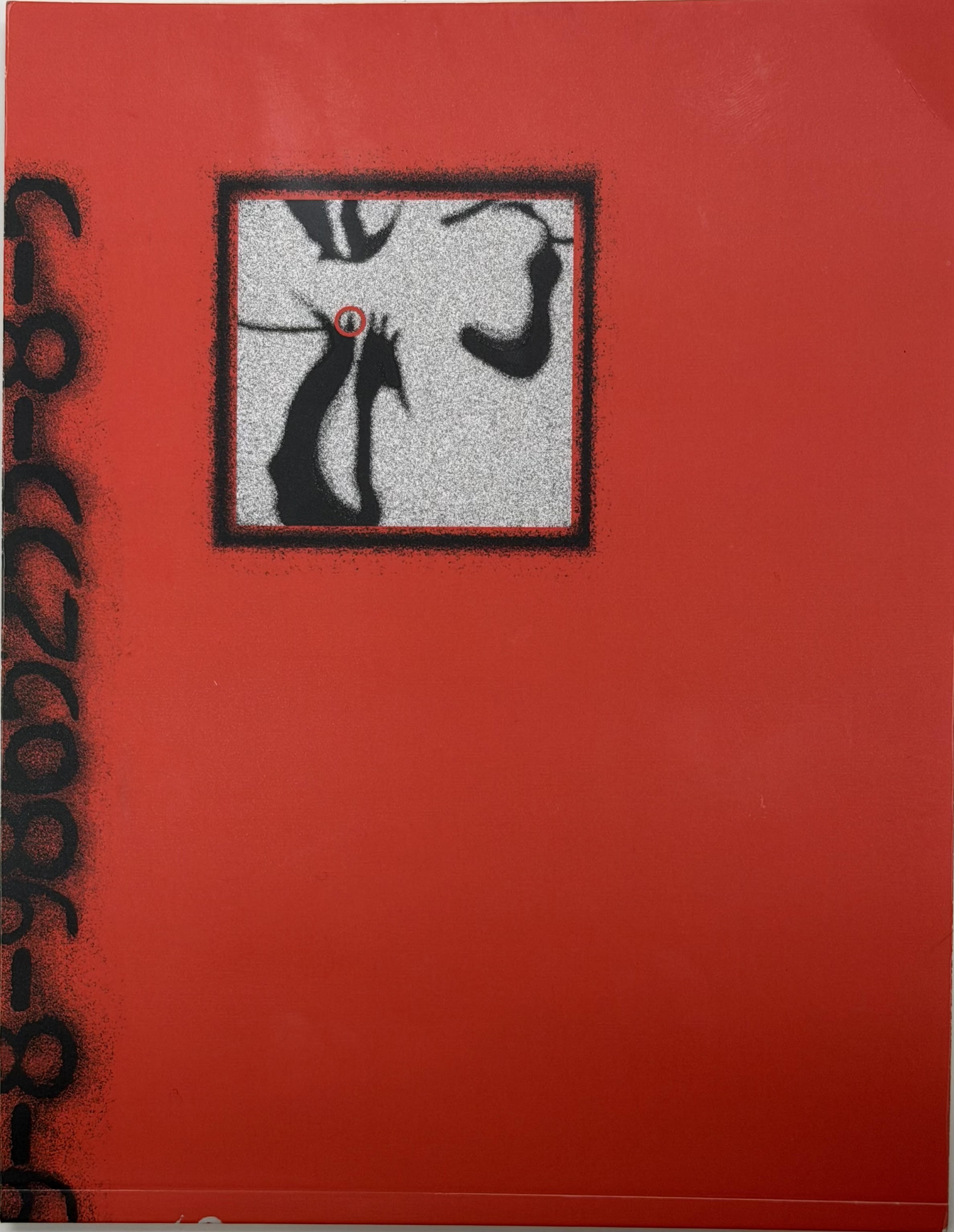
Lessard’s collection is 96 pages of joyfully unpredictable poetry. The book is a red rectangle, the color of the Chinese flag, marked with a numerical code smudged almost into a charcoal blur. The central image of the cover is a face that recurs throughout the book. The eyes are clenched shut, as if suffering from a migraine or perhaps trying to hide from technology that is stealing their likeness. A small red circle focuses on a single wrinkle on what is called the procerus muscle. This face and a similar face with open eyes are present throughout the entire book.
The title /face appears only on the spine in white letters. The forward slash (/) can represent a URL code, a poetic line break, data or numeral separation, fractions, or the indication of two alternates. In the latter, one alternative is “face” while the other alternative is blank. It speaks of absence, erasure, a missing identity. All in all, it is a fitting symbol of the warning the book offers its readers.
Ultimately, Lessard’s collection reflects on poetry in our digital age and asks us, “Who controls the face?”
The face is no longer a sovereignty. (p. 35)