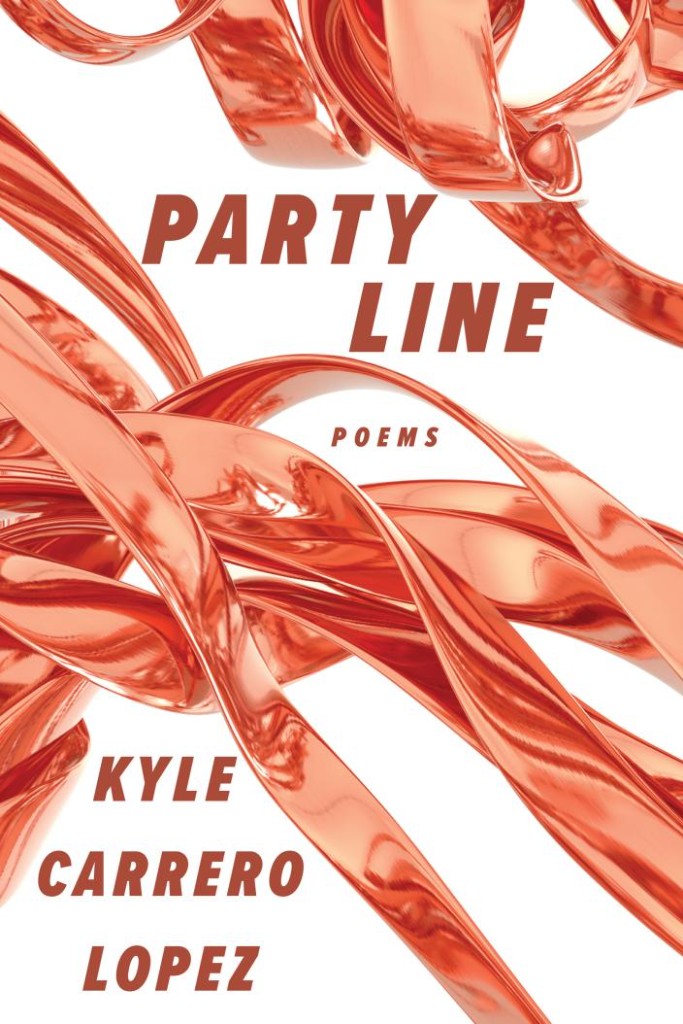
Party Line by Kyle Carrero Lopez. 88 pp. Graywolf Press, 2026. $16.00.
Kyle Carrero Lopez’s Party Line roots queer space and late capitalism in immediate physical experience. A quiet intelligence drives the house-track pulse of the book. The guest list and the velvet rope operate as active engines of desire and exclusion. The dance floor looks democratic. The question persists: who actually gets through the door and who remains outside.
The title collapses political doctrine, a shared telephone line, and a literal party. A political faction, a nightclub, or a mother fighting for medical insurance all run on the same cruel logic of distribution.
The speaker occupies the position of a “lower level” subject of late capitalism—a queer host, a worker in the club economy. Lopez drafts an “I” conscripted into servicing other people’s pleasure. This body encounters the micro politics of entry, where “Are you on the list?” constitutes the primary mechanism of control. The prose poem “Public Policy” tears down the radical posturing of these spaces. The very people who “craft lengthy manifestos on community care” charge fifty to eighty dollars at the door. You can “cruise utopia nightly for the price of one disposable income.” Queer nightlife loses its romantic veneer; community itself carries a steep price tag.
The club promises freedom. Yet everything around the dance floor remains tightly regulated. Security, borders, and immigration merge into a single speech torrent: “HELLO WELCOME how you doing. / ID please. What brings you here. / … Give me your right wrist. / Your RIGHT wrist.” The language of control hijacks the rhythm. The penalty is heavy for any body that fails to generate revenue or maintain the vibe. Power operates directly through these ordinary spaces, turning the sheer conditions of movement into profit.
At a Fire Island party in “Phragmites,” the speaker spots men whose “wealth eclipses mine / and that of most of / humankind.” He recognizes what separates them from everyone else: they remain “gated from scarcity.” Long, breathless lines mirror the tension between bodily pleasure and constant social awareness. The speaker dances. He also reads the room.
State power weaponizes everyday objects. In “Embargo (ADDENDUM),” drugs and syringes turn from neutral medical supplies into instruments of absolute domination that reach directly into Cuban life.
In “The Socialite,” the grandmother constantly grips her phone—the vital node connecting a fractured family. Her factory life reveals the invisible reproductive labor keeping these families functioning. She performs the undervalued work of repair that capitalism demands but never pays for. Remembering a grandmother whose life unfolded “of and in an us” offers a blueprint for sustaining care across generations.
Against her stands the speaker, a member of the contemporary cultural class acutely aware of drifting toward becoming “a product.” The cultural industry routinely metabolizes grief into marketable content, tempting the artist to “peddle sadness /… just to book bigger gigs.” The speaker’s love for his grandmother establishes a rigid ethical boundary: “Let me always be a person of people, / a socialite like her, before a product.” If the older generation’s labor built the “we,” the younger generation must decide whether to inherit that commitment or allow individual ambition to hollow it out completely.
In “Ode to the Crop Top,” a simple garment transforms into both a “slut / symbol” and a “short / story.” It gathers pleasure and self expression into a single, volatile surface that attracts desire while drawing the gaze of those who police it. The tone shifts precisely from club slang to a spare political register.
The splinter-poems in Party Line—“Bloqueo (Social),” “Bloqueo (Rescuing),” and “Sanctioned Steel”—rupture the book’s architecture to expose the material base of poetic production. Lopez imposes a deliberate deficit, assembling these texts from half the words of their predecessors. The Cuban embargo is pulled inward: blockade as syntax. Lopez takes Jameson and Eagleton at their word: if form is compressed historical experience, this depleted language is material scarcity made flesh. The poetry operates under severe austerity, scavenging for meaning in a direct mirror of the daily labor of survival.
The method is strictly Adornian. Faced with capitalist totality, the text demands fragmentation, a refusal of synthesis. Self-expression collapses into violent deprivation. “Bloqueo” enacts the sanctions directly on the text’s body. “Sanctioned Steel” pushes this ingenuity beyond metaphor: the poem is the machine, running on scavenged parts. Inside this flickering language, Lopez locates radical potential: the desperate inventiveness of the stripped. The scraps reassemble themselves.
“The Rules” draws on Adrian Piper to construct a practical survival manual. The declaration “I will always be too expensive to buy” forces the speaker to figure out how to survive inside a system he cannot easily escape. Everything already exists within a market logic. Capitalism routinely absorbs resistance. The book leaves this contradiction wide open.
Political violence echoes intimately through family life. The piece about the bombing of Cubana Flight 455 bypasses conventional historical distance. History bleeds directly into the “now.” Temporal layers collide. Cuba and the U.S., the Cold War and post 9/11 plait together into a dense knot of memory and ongoing struggle. The clubs and clinics belong to our world, shaped by neoliberal systems. Carrying the weight of history inside the current moment forces time to become an active, unresolved problem.
Tolstoy’s epigraph takes on a radical charge. History persists in grandparents’ bodies, in embargoes restricting medicine, in the rigid blueprints of prisons. The crucial question asks what can be done right now, within these inherited conditions—on this dance floor, at this checkpoint. The epigraph insists the only moment available to act on these structures remains the present. “The time when we have any power” names the compromised “now” of late capitalism, where even small acts of refusal and solidarity accumulate historical weight.
Joy and critique are never at odds here. Emma Goldman famously declared a revolution without dancing worthless. Party Line treats this as material reality: pleasure drives the anti-capitalist struggle. The party is undeniably a site of exploitation. Yet it also forces bodies to reshuffle, opening up temporary spaces for new solidarity. Revolutionary imagination bypasses office-clean clarity. It sparks in the grime of the club floor and the tense silence of a subway car. That is the only party line worth holding.