DM Please comment: “Disclaimer: This book was solely created by a human & includes no AI-generated content.”
Well, let me first say, that as we all know, in in this contemporary mediatic environment, even if we’re not using Claude or ChatGPT it’s ubiquitous, everywhere – Google Maps, autocorrect, face recognition, spam filters – integrated in our daily tech, “invisibly” streamlining and predicting. With that being said, i wanted to underscore that though many of my colleagues are proudly n excitedly using AI to generate their work, for me, creating it “myself” is the greatest pleasure — “working” the art, through the pain, the play the comedy n cunning, every step of its creation; every interventive / poetic / philosophic / Kabbalistic n musical reference; every graphematic mark, syntactic cluster, each rhythmic textured, phonemic flourish – (in the words of Eric Carmen), “all by myself”
DM Would you define yourself as a political poet?
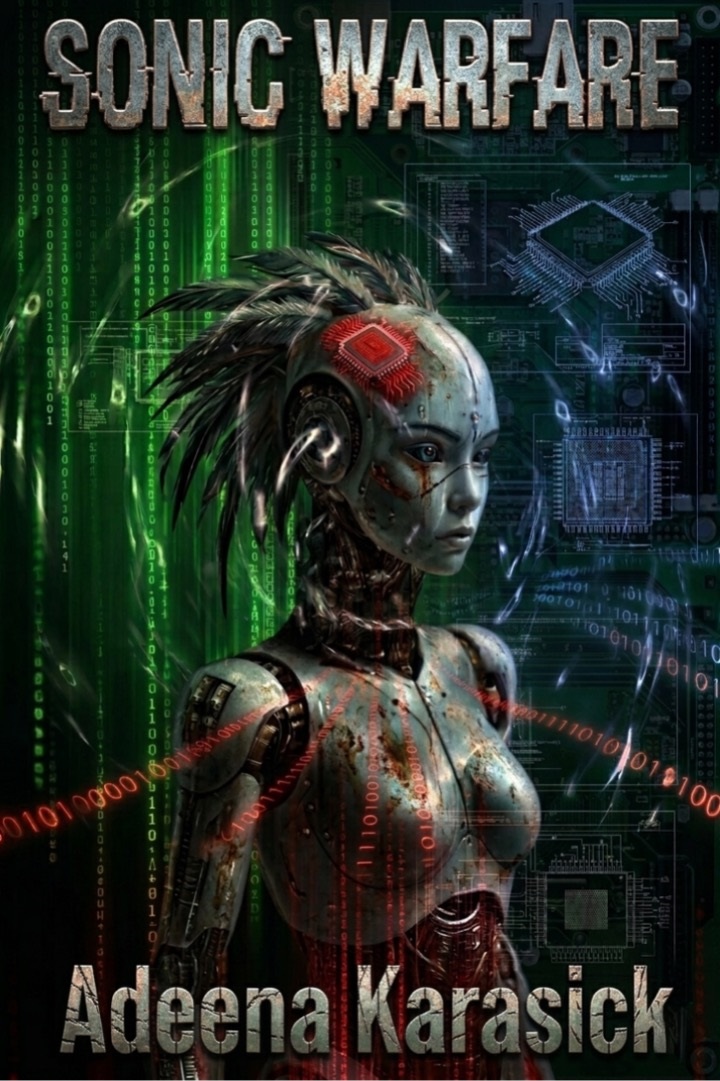
Isn’t all poetry political lol? In Finnegan’s Wake, James Joyce speaks of a “MindWar” to combat and undermine the structures of “awethororty” through humor and levity…using linguistic tricks and “erotic magick,” asserting how subversive language practices are themselves prophetic peace protests. In many ways, Sonic Warfare too, is engaged in a “war in words,” declares ‘war’ in language, on language and by language; asking us to rethink our relationship to received values; underscoring how polyvalent subversion defies mastery – and how it is here in these unstable intervals – a philo-political-socio-gendered-lingua-erotic anti-authoritarian invitation for the re-negotiation of received info.
DM When did you first fall in love with language?
I’ve always been obsessed with language; as a technology, a prime mover in the re-distribution of aesthetic values; ways that it’s physical / material / sonic, the building blocks of creation — and through permutation and combination, meaning is ever-reproduced in wild ‘n unexpected ways – as an arché-textural lexical elixir, a languescape of letters; a textatic habitat to live in.
DM What is the relationship between poetry and sex?
Aren’t they the same ; ) Lettered bodies of curves, crevices, invaginated surfaces letters of desire, curling in on each other connected n re-connecting through forces n intensities, re-creating new perspectives of pleasure, power n promise. And costumed with unravelling; in the coil of split slits surfeits straddling across my logos in the frill of disclosure, these letters heaving all naked with their haunted rocking all synchronous, sinuous succulent in the valleys of frisson’s filial flummox.
DM Is this a rap? “Bloom doin Molly/Audible is doin’ edibles”
I’ll check with Drake, n see if he wants to set it ; )
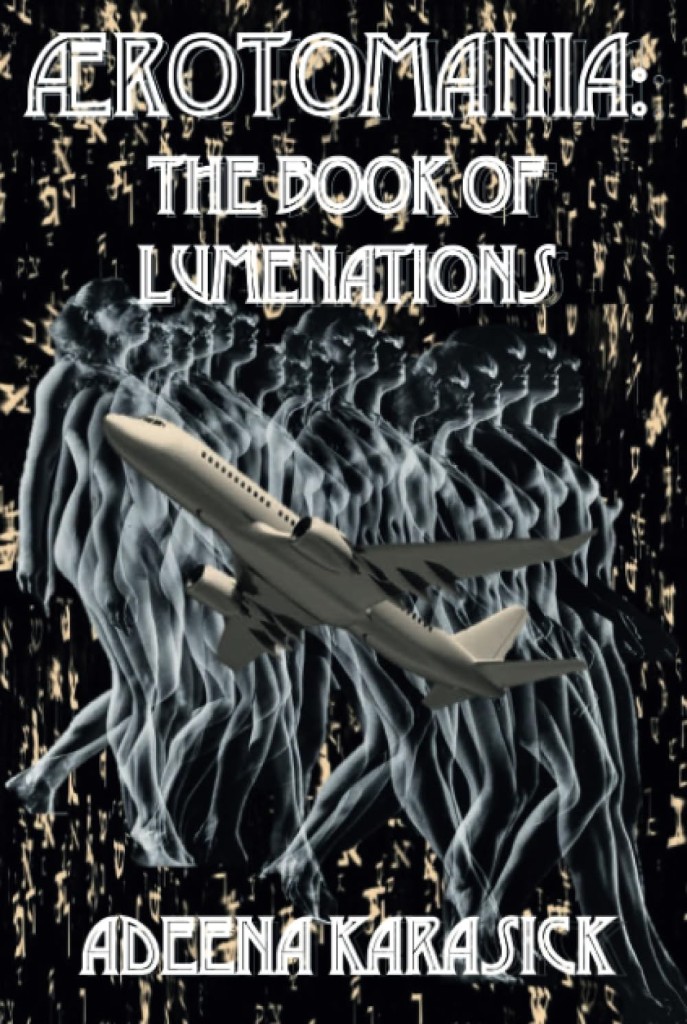
Lavender Ink, 2023
Less rap n more like a wrap – as those lines are part of the “Checking In” section of the book – it’s the 3rd installment of an ongoing investigation into our over-saturated media environment – an ironic listing of one-liners, highlighting how there’s always a political economy of technologic knowledge. Part I appears in Checking In, (Talonbooks, Vancouver, 2018); which we talked about at length in a previous interview here; Part II is in Ærotomania: The Book of Lumenations, (Lavender Ink, New Orleans, 2023), and as a 12 min. vispo film, and was prominently featured in VIDEOPOETRY: 1980-2020 at the Surrey Art Gallery in Vancouver, 2022. Similarly, this 3rd installment also exists as a videopoem again co-created with Andrews. i provided him with 500 images that relate to the text, and he imported it through his graphic synthesizer he developed, Aleph Null, and you can see it here. The text was also sampled (along with “Desiring Machine”) for the Adeena Karasick Boss Monster Poet in Arteroids, the first ever shoot-em-up poetry video game created by Andrews.
DM Do you recommend reading this book in a library that requires strict silence among its patrons?
Does this mean it made you LOL? I had so much fun, punctuating it with weird pop references / nursery rhymes, subverted cliches – really speaking to the flattening or de-hierarchization of language, so maybe best not to ; )

DM Your publisher, Roof Books, has in its own terms published “the best in language since 1976.” How do you regard your own poetics in relation to so-called “Language” poetry? Do you do “Language” with a supplemental difference?
I’m resistant to categorizing myself — as the work is drawing from a range of neo Fluxus, post L=A=N=G=U=A=G=E, Sound Poetry, Concrete and Vispo models; framed by a fiercely feminist aesthetics of transgression, invasion, contradiction, ambiguity, ornament, excess, paradox and desire — occupying a liminal space, on the borders of so many genres / schools, movements. But with that said, i feel blessed n so grateful to have this work published alongside all my esteemed L=A=N=G=U-A=G=E heroes, sheroes, rebels, renegades n fierce, revolutionary literary sculptors.
DM Why do you repeat certain phrases such as “This word is a digital immigrant,” “Ride with me,” “Who is weaponizing,” and “What is certain”
Well in one sense, for its rhythm — but i’m particularly interested also how á la Stein, Baudrillard, repetition is reproduction Every time articulated it’s re-constituted, made new, re-contextualized through a range of socio-technologic, political-aesthetic and geo-historic modalities.
DM This book includes phrases associated with Trumpism: “flooding the zone,” “indictments,” “weaponizing,” “immigration,” “sex trafficking,” “self deporting/through taxed cracks,” “with a side of crushed ICE,” and “illegitimate amnesty” among others. What happens to these MAGA terms and talking points when you reframe / appropriate / play with and on / pun / morph them in Sonic Warfare?
uhhhh am making the Murky Great Again ; ) Invading the text with the lexicon of the moment yet playfully subverting it, not only and kinda hermeneutic n super fun to write, but really speaks to how we are so shaped by this media apparatus – and through this provocative, satiric intervening, unleashes a bit chaos, disempowers the language – cuts into the quiet comfortability / familiarity of these “talking points.” Taking the familiar n making it strange. Simultaneously commentary and critique, harnessing that language and contaminating it, enabled me to say the unsayable, elevate the mundane; and through lexical mixing, combining, spinning, twisting reference, syntax, idioms install a new set of symbolic and iconic values, (as Johanna Drucker might say), “saturated with suggestivity” as we negotiate this raging technopolis we now live in.
DM Is the traditional relationship that develops in lyric poetry between an “I” and a “You” possible (or made even more possible?) in the context of AI and LLMs? Or put another way, does your new book help answer Roger Daltrey/Pete Townshend’s query: “Who are you? Who the fuck are you?” Who (or what?), in other words, is “trafficking//these letters”?
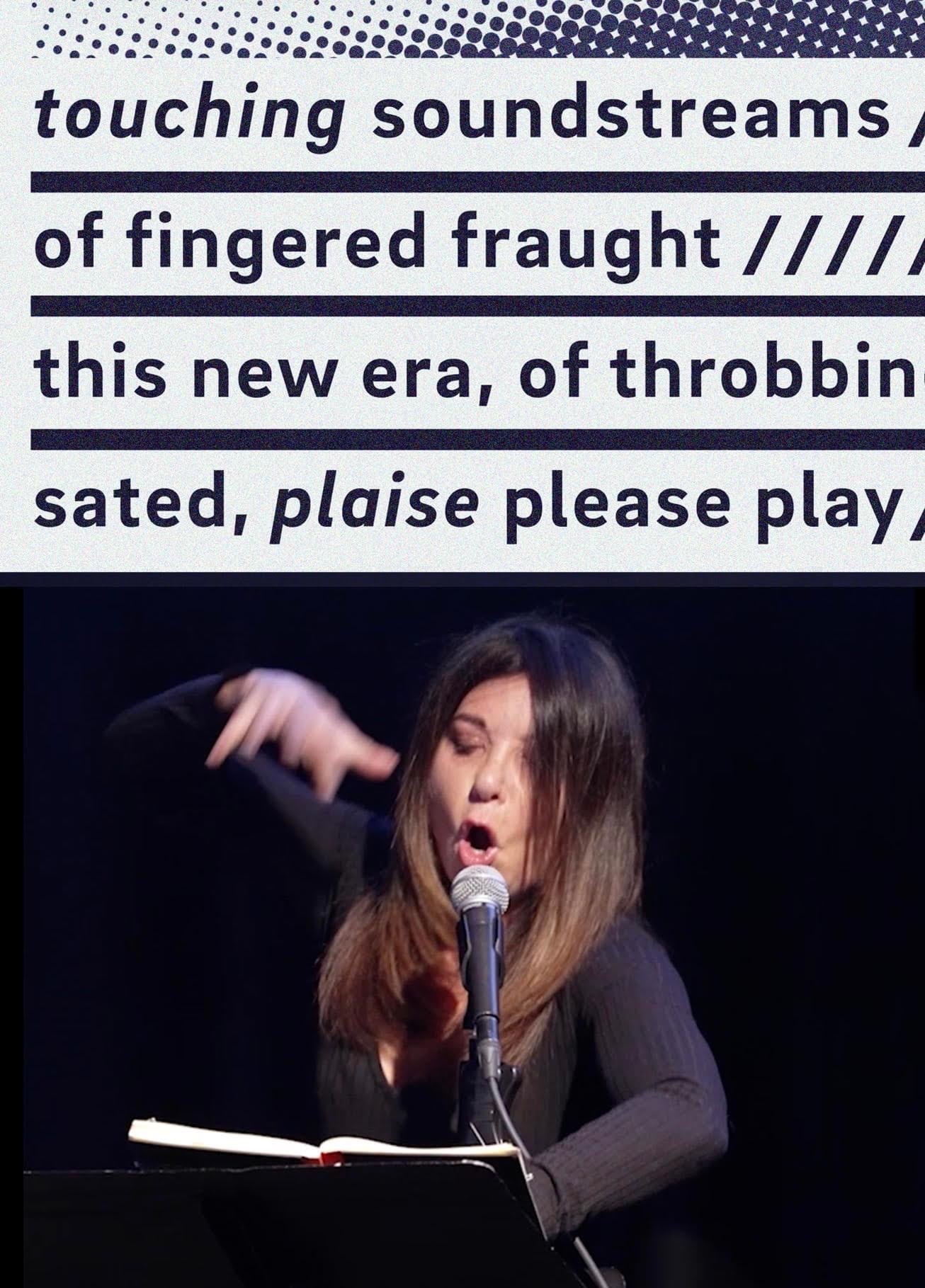
Is an “I / You” dialectic ever possible? Subjectivity is always slipping between difference, appliance, appearance / between various translations, editions, renditions, additions, permutations and re-combinations. “I” am multiple subjectivities inscribed along shifting axes of influence. “You” are a projection. Is identity ever fixed or stable? So Roger Daltrey / Pete Townsend maybe the question to be asking is not so much “who are you” (when in fact as-co-creators, you are already multiple), but who is the you i am touching today / in the today of wild touching; the today / of withholding, the today of passionate rations, measures, erasure / la cirque of screaming caesurae / and the today of sweat rimmed arcs ribbed silken crypts / scripts slips slits limned swept through anguish tangents, torments / thresholds, strongholds of sun sucked wet lex, lips, stilts, lilts in the double bind of desire / in the proximity of the intimate / intervals of distance –
i guess we have to re-translate the old Buberian axioms of I / Thou, I / It to I / I.T. For, between the I and AI / when A I both A + I recalibrated in the infinitivity of molecular constellations, cellular configuration in the ever d’evolving crevices of our dis/similitude.
DM Can poetry protect us from being eaten by LLMs?
As per one of my fave films, Jean Luc Goddard’s 1965, Alphaville. Isn’t it poetry, paradox, philosophical probes that explode the system. So… yeah.
DM Can being silly, goofy, irreverent, contradictory, untamable, and flat-out other serve as strategies to save humanity from the AI Pac Man – which you so humorously reference after your homophonic translation of Pound’s Canto 45: With UsurAI
Well, i think so! Especially in that partially what defines us as human is our embrace of contradiction, juxtaposition, the mashing up of political difference, defiance, fragmented histories, cultures, codes, without always needing to wrap it up into some linear / logical package. i love occupying this liminal space — inside the lexical excess, the flirty flexicon of fixity mixes, a nexus of synnexes, annexes, diexis of lexically-sugared circuits showing us how the future is always arriving from itself, in an excess of excess of transcriptions, translations, what Derrida might call “a nonhistory of absolute beginnings,” celebrating all that is nomadic and vagrant and “on the edge.”
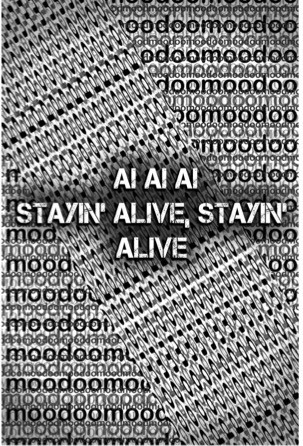
DM Discuss your enjoyment of playing with pop: “I got the algorithm in me,” “Just Eat It,” “G-L-O-R-A-I,” “Bet your bottom dolor,” “Stayin’ Alive,” “In your Eye,” Slow down you move too fast/You gotta make humanity last,” “my my my degeneration”…
I find, it’s so politically and aesthetically interesting (and fun) taking difference registers, tones, discourses, dialects n mashing them up in an intra-textual poly-aesthetic multi-temporal juxtapositional parade : ) palimpsesting philosophy n poetry, science n technology — taking some 70’s or 80’s pop song n ramming it up against deep seated 13th C. Kabbalistic secrets of the creation of Being with Pound, Lacan, Artaud, Maimonides, 2nd C. rituals of Golem Creation, with Mary Shelley or the 613 Biblical commandments with contemporary mediaspeak. For me there’s a great pleasure in the leveling of knowledge; the de-hierarchization of meaning — acknowledging ways time is contemporaneous – that we are living in a resonant present — like Benjamin’s, “Jetztzeit” (now-time), ripe with revolutionary possibility; carrying the continuum of history and poised to leap into an ever-becoming future.
DM Do you believe/think we live in a Post-Truth era? (“where is the fact in factory”?) Maybe there is a difference between truth and fact?
Well one way of thinking about it is that “facts” ie mathematical axioms, scientific data are verifiable, and truth is contingent, contextual, multiperspectival. So, i don’t know if we are any more post-Truth than ever Were we ever in an era grounded in overarching platitudinous notions of Truth, Authenticity, Closure? These terms need to be interrogated.
Throughout the book, and certainly highlighted in the final portion, “On the Uncertain Certain in the Counterpoise of the Unthought,” i unpack how etymologically “fact” comes from fake, from “facio, facere, feci, factum, as we face the defaced tenets of re-assorted sordid absorption submersion diversions revisions diversions / admissions / submissions emended all numinous, luminous, voluminous / through webs of belief.” So, perhaps it’s important to acknowledge that in this contemporary world where everything is shifting and unstable, that though our media tells us that what we’re seeing n hearing n feeling is not real; that trust is contingent --- between the definite indefinite probable, improbable pliable, palimpsested, polymorphic posits— we need to carve out a reality that we can live with.
DM Reading Sonic Warfare, I was reminded of a popular paperback that the off-campus stoners kept a copy of in their unclean bathrooms when I was an undergrad in the 1980s: John Berger’s, Ways of Seeing. Any resemblance in your eyes?
in many ways yes! If i remember that was a book of literary criticism talking about how art / ads shape cultural perception and power; critiqued ways traditional elitist views of Western art, political and historical contexts dictate how we perceive images. Sonic Warfare, also offers new ways of seeing, asks the reader to re-negotiate this new contemporary “reality” as we drown in slop, in deepfakes, unable to determine what’s artificial / interstitial as the “real” reels between the surreal, irreal, corporeal; between the seen and unseen, AI’s ever-immersive messy emes’ mise en scene. ((emes, in Hebrew is truth)).
DM Thinking about what’s seen and unseen, visible and invisible, what is the significance of white space/negative space in your poetics?
i love plying / playing with the landscape of the page; where the letters caress the page through a range of entrances / textures / frames – where it’s not just the words that communicate but all that they are framed by. Employing typographic elements that ask the reader to not just effortlessly consume the language but to slow down, let oneself be massaged by it, play inside its lexical excess, its otherness and defamiliarity. i also really like thinking about how 13th C. Kabbalists saw the ink on the page as black fire on white fire – highlighting how the page itself is not just a receiver of info but IS itself communicating, conflagrating. So white space is not negative space but all that is not immediately visible — what Kabbalists call the secret of the “white letters.” According to the teaching of late 18th C. and early 19th C. Hasidic master, R. Isaac of Berditchev, disciple of R. Dov Baer of Mezeritch, the Great Magid, “not only do the black signs constitute letters but the white spaces that constitute them.” The white space stands in for all that is invisible, visible, risable, li[a]sable / entwined in each other / and as black light drenched in white light pressed against / purring torment as / lettered sweat seeps through / muffled shouts, splits, rips rocketing darkness / as the night squats / strapped against the sky…
DM Is this book a Golem? In what way does it serve you?
Hmmm ; ) is this book a Golem? Well, like how early rabbis created something in their own image, yeah — and even more than that, it was created out of code, systems of combinations and permutations / lexical distribution. So, yes! This book could definitely be seen as a Golem. And it’s true, these early avatars were meant to serve their creator, perhaps not so much in the de Sadean sense, but as i mention in Sonic Warfare, during the medieval period, Rabbi Samuel, father of Judah the Pious, was said to have had a golem as his valet. And well, this book certainly drove me to new destinations of seeing n being / drove me wild / drove me mad. Dressed me “through the spectacle of high fission / through ignoble ingests, insets / twinned-set datasets / gridlocked cross-talk / of Tik Tokin’ catwalks … on immersive runways in shape shifting hardware / shareware / software / spyware / malware…” Further, like a Golem itself, for me, the book, this book is a kinda living machine, “an aspect of our embodiment” that both generates and obscures signification —
a living text of lips pressed cross-kissed cryptic schize
a sanguine text that replenishes and re-creates itself
as a lexical excess / a nexus of s’nexes, annexes, deixis
of lexically-sugared circuits reveling in a raging
plagiary of collaborative rapture
DM Are you a dancing machine?
More of desiring machine ; ) A dance of letters, meaning / a “dance of the intellect”
DM Were you influenced by Gerard Manley Hopkins’ concept of “sprung rhythm”?
Well not really, because as i understand it with “sprung rhythm” each foot begins with a stressed syllable followed by a variable number of unstressed syllables, mimicking the natural rhythm of speech. Though this book specifically draws on some rhythms of “natural” speech, is much more influenced by Jazz, n has a kind of fugal quality, i’d say. It’s marked by unconventional and non-traditional language, foregrounding notions of fragmentation continual modulation and polyvocality. Full of “illegal inversions”, subversion. Sometimes voices arise that are enmeshed inside the syntax, and sometimes voices arise that are more demonstrative and respond. These voices (or sonoric resonances) caress each other play off each other producing a combination of subject and countersubject, augmentation and dispersal.
Interestingly, the word “fugue” is related to both the Latin “fugere” (to flee) and “fugare” (to chase); how language is both fleeing, escaping from and chasing meaning which always already is in excess of itself. As such, Sonic Warfare offers more of an “upsprung rhythm” ; ) Inscribed in abundance, overflow, supplement and desire, it’s always exceeding its own “meaning”.
Also its kind of fugal in the way that its comprised of many voices which enter and exit episodically; becomes a series of tonal responses that is brimming with countersubjects, intersubjectivity, conflicting harmonies, sassy assonance / a SAASy dissonance of entrances and exits but never arrives at a resolution – But rather is marked by contrapuntal lines that are not written according to certain rules (or regiments) but are constantly playing with intervallic combination and inversions and erupt in a plethora of voices, pitches, subjects, questions, answers (to questions that have never been asked), n marked with brief codettas. So maybe less Hopkins and in the words of WCW, Spr[u]ng and All ; )
DM How do you reconcile Pound’s anti-Semitism and Far Right Politics with his value to you as an innovative stylist?
That’s a deep n complicated conundrum. If we silenced or absented all the poets, composers, philosophers n thinkers who are politically problematic, we would be missing a whole aesthetic history. Am i gonna cancel Nietzche? Heidegger? Never listen to Wagner again? – For me i try to compartmentalize the politics and let them teach me / be inspired by all the ways i can enjoy them. Also – when possible, i love subverting, transgressively intervening like i did with “With UsurAI” – taking his misogynistic anti-Semitic Canto 45 and homophonically translating with a femmy, jew-ey re-newed technological silliness—highlighting not so much the Jews as usurious but the usuriousness of AI. Bottom line, i think we got to valorize not them but the work.
DM Like the old adage told to children, is Adeena’s poetry better seen than heard?
LOL i don’t know about that – but what i can say is i’m really interested in ways the book “seen” (read) and the book heard occupies two different yet interconnected mediatic environments; each offers a range of stylistic effects that impact its meaning production. ie when heard, one can immerse oneself in its shifting tonality / rhythms / polyglossic play — and on the page you can feel the landscape of the page as a palate, it’s typography (which Johanna Drucker calls “the dress code of the letters,”), various framing devices of syntactic, graphematic puns – which may be seen yet not heard.
DM Are you a scat singer?

uh more of a ersatz slinger….
DM Is this book your Guide for the Perplexed?
Well Maimonides’ brilliant 12th C. Guide reconciles Aristotelian philosophy with Jewish theology to guide those troubled by apparent contradictions between reason and revelation. Sonic, Warfare however, is grounded in what i’d call more of an anti-Aristotelian logic and celebrates contradiction. Invites the reader to play in the liminal spaces between connection and disconnection; empathy and detachment. And perhaps in this way, it can offer a discursive model a “guide” which presents not a non-ironic, over-sentimentalized discourse which glosses over darkness, tragedy, and discomfort but rather one that is both distancing, subversive and full of affect, and thereby underscores how modes of complex communicative strategies problematize the foundations of systemic infrastructures, crucial for transformation and change.