
AP Your poetry repeatedly subjects language to conditions of formal pressure: syllabic counts, inherited forms, repetitions, serial structures, constrained syntax. Yet you have said that form is not a source of safety but something that propels the work toward “noticing, discovering, and becoming.” This seems close to a paradox explored by Adorno: constraint can become the very condition of aesthetic freedom. Do you think of poetic form as a discipline that produces freedom from within discipline itself? And what distinguishes such a productive constraint from the disciplinary mechanisms that organize social life?
Yes, I do consider poetic form as a discipline that produces freedom based on such discipline. I have freed myself to apply numerous different strictures to writing projects to encompass whole books. I concur with Adorno that constraints are fundamental to artistic freedom. Applying the vehicle of a structure supports the commitment to discovering then releasing what is real. It is also relevant here to mention that giving in to social pressures to become recognizable with a “voice” has always struck me as not positively constraining, as my forms are there to be generative of more.
AP There is a striking tension between your work and the traditional idea of the lyric subject. Your poems often seem to distribute perception across fragments, sounds, objects, memories, bodily sensations, social realities, and linguistic accidents rather than allowing everything to converge upon a stable “I.” Could we say that your poetry attempts to move from the sovereign subject toward something more relational and distributed? I am thinking here of Judith Butler’s account of the subject as constituted through relations with others, but also of Marx’s insistence that the individual is always already embedded in social relations. What, for you, happens to the poetic “I” when it ceases to be the unquestioned center of experience?
I find traditional lyric subject is not only limiting, but sometimes smothering. The fluid act of writing means that unexpected, even sometimes unwelcome realities may show themselves. Lines emerge seemingly from the littering, I will call it, that may feel as though it has emerged out of nowhere. Equally, a poised, sustained feeling of evening (in both meanings) may occur, closer indeed to the traditional lyric. I’m thinking of a tiny recent poem of mine titled “Pearled | Held | Spare.” Here what feels like a lyric continuity emerged from multiple fractions of experience, brought together.
AP You have spoken about “perpetual listening” and about being in a “continual act of ear tuning,” describing poetry as something that emerges through listening to speech, sound, silence, and the world around you. This makes me wonder whether poetry, for you, begins less with expression than with reception. Could writing be understood as an attempt to become permeable to forces that precede the individual intention of the poet? In other words, how much of a poem is authored by the poet, and how much is allowed to emerge from language itself?
You’ve nailed it here, Aleksey. For me, language coming from otherwhere rarely disappoints. Poetry originates around me. Wherever I hear whatever I hear advances my enjoying, amusement, and always my learning. It’s important to say that I do not advocate splattering the page with raw material. Taking raw material and creating a shared act in concert with streams of others’ perceptions is how I see this. Poetry is less “about” expression than coming to life by way of receiving sometimes unexpected signals. On the spectrum ranging from expectation to surprise, I place my preference squarely at the “surprise” end. Sound runs continuously all the time around me. I plug in and go with that stream, shaping something new.
AP Your poetry has a remarkable capacity to make disparate things coexist without immediately subordinating one to another. A phrase, a political reality, a bodily sensation, an object, a memory, a scientific term, and a sound can enter the same linguistic field. This reminds me of Walter Benjamin’s idea of constellation: meaning arising not from a hierarchical system but from the sudden proximity of heterogeneous elements. Do you consciously resist the hierarchies through which ordinary language organizes experience?
Thank you for reading my work this way, Aleksey. For me, poetry begins everywhere, and Benjamin’s idea of constellation certainly becomes a prompt to the poet’s taking responsibility for arranging and shaping a wide variety of material. And to call it material in no way means to subject that array to a subordinate position. The concept of hierarchy defies the beauty of individual experience and knowing. The integrity of infinite points of understanding within different individuals prompts a deserved respect, the most natural and frankly poised way to understand our surroundings. Hierarchy has been established as the province of the insecure who appropriate and even seek to own others as though this were a legitimate way to function. Humans are social creatures who have the capacity to develop cooperative mechanisms to foster both shared and independent production. Coercion has no place.
AP Your poetry often seems to remain remarkably attentive to the immediate world — to ordinary encounters, passing perceptions, fragments of speech, objects, sounds, and small shifts in consciousness. Marxist thought has often asked us to look beneath apparently ordinary objects and practices for the social relations that produce them, while phenomenology asks us to return to the density of lived experience itself. Does poetry allow you to hold these two movements together — the material particular and the social structure that surrounds it?
Yes, it does. The creating act of perceiving means nothing is truly ordinary. The ideas of Marx and the offerings of phenomenology are certainly blend-able! There is richness everywhere, waiting to be seen, heard, sensed in whatever way. Infinite “prompts” for whatever an artist chooses act on as a source for discovery.
AP You have spent much of your professional life working as an organizational consultant and educator, while simultaneously developing one of the more radically experimental poetic practices in contemporary American writing. I find this conjunction extraordinarily suggestive. Organizations depend upon classification, procedures, roles, measurable outcomes, communication protocols, and administratively legible forms. Your poetry often seems to do almost the opposite: it multiplies meanings, destabilizes categories, interrupts syntactic expectations, and refuses easy legibility. Do you experience these two worlds as opposed systems, or have they perhaps taught you something about one another?
In my “other work” in organizational consulting, we have a devotion to systemic thinking, as we define that: a blend of systems thinking, critical thinking, and design thinking. In 2024 Routledge published a book I co-authored with two colleagues: Systemic Thinking for Public Managers: Five Practices for Creating a Vibrant Organization. It is our belief that this conjoining of thought should factor across all organizational endeavors. Although the words “organizational consultant” may suggest the procedural, even bureaucratic aspects of organizations, our take in our consulting is radically different. While we are very good at organizing and structuring in general, we seek to guide organizations away from bureaucracy and toward inclusiveness that can build improved, shared, diverse thinking and prompt the design of increasingly stronger and more purposeful organizations. Bureaucracies typically become self-sustaining, self-promoting entities that readily cease to support the original purposes for which the organizations were created in the first place. They come to squelch human ingenuity. Being truly good at leadership and shaping and structuring can transcend the way things presently are.
Thinking creatively, respectfully, and freely while working hard with others is the beginning of building, creating, and sustaining an environment that supports learning and production in the best ways.
AP This question also makes me think of Foucault’s analysis of disciplinary power. Modern institutions increasingly operate by making people and their activities measurable, classifiable, observable, and administratively intelligible. Experimental poetry can seem to perform the opposite operation: it produces forms of language that resist immediate measurement and classification. Do you see linguistic indeterminacy as having any political potential — as a way of interrupting the demand that everything become transparent, legible, and useful?
Discipline when self-designed and self-imposed can sustain rewarding practice. External control and power defy creativity and amount to slavery. Innovative poetry can benefit from linguistic indeterminacy that asks a great deal of the person experiencing the created work to reconsider art and even life itself. Ultimately, art facilitates self-transformation.
Transparency, legibility, and utility become ironically feeble concepts if and when they interfere with creation. Watering down creative gestures and product mean sacrificing the distinctive facets of a work in favor of dumbing them down to be approximately understandable to people who prefer not to invest time in experiencing and understanding.
AP Your work often produces an extraordinary surplus of language. Words seem to generate further words rather than simply delivering information. From a Marxist perspective, one might describe this as a refusal of linguistic economy: language ceases to behave like a transparent instrument whose function is to transmit a determinate quantity of information as efficiently as possible. Could poetic excess itself constitute a kind of resistance to the instrumental rationality of contemporary capitalism?
Sure, it can. As you well know from your own remarkable work, Aleksey, the artist may not have complete control over the inflow of words, syllables, empty space, punctuation, and the like when engaged in the act of making. Feeling required to oversimplify often becomes a consideration. What we choose to do amid the seeming infinity of possible directions means we need to make an independent decision about the probable outcome of our work. There’s a logic we need to find within our work and trust and follow that stream to generate what we believe must be done. Writing is indeed its own imperative.
Writing is a vehicle for asserting the truth and reality of what one discovers and thinks, rather than an act of genuflection to what would be better resisted by the writer. The urge to monetize can conflict with true artistry.
AP Adorno argued that artworks can resist domination precisely through their refusal to become immediately assimilable to the world of exchange and utility. Do you think experimental poetry still possesses such a capacity? Or has contemporary capitalism become sufficiently flexible that even linguistic difficulty, formal experimentation, and aesthetic refusal can themselves be absorbed and commodified as markers of cultural distinction?
I often wonder, as you clearly do, what a small “movement,” if we wish to call it that, can accomplish within the larger sphere. Writers of mainstream poetry appear to have proliferated amid graduate programs in writing. There’s a market there for books that have been “blessed” by such programs, and thus prompt scores of people to strive to “win” that de facto game. Commodification has been in play here, as you suggest. In an ideal world, work that stretches itself and somehow miraculously becomes the subject of notice (a typically arbitrary and rare thing) can attract followers who in turn may try to emulate what they see, the consequence of which is yet more of a burgeoning of “yes” people. While it may appear that people have joined a movement to remake the world, we tend in our larger cultures to produce far more followers than leaders. There comes a pattern of following would-be leaders who are often greedy, self-serving individuals. Sadly, the art world and the writing world are not immune to such issues or practices.
AP Your poetry is deeply musical, but the music does not simply decorate meaning; it often seems to generate meaning. A sound can redirect syntax, a rhythm can alter a sentence, and an acoustic resemblance can establish a relation between things that semantic logic would keep apart. Does this suggest that language has a material life that precedes or exceeds its communicative function? And if so, might poetry recover something that ordinary instrumental language has suppressed?
I find this a beautiful question, Aleksey. Your point about music’s not simply decorating meaning but rather finding then generating meaning is important to me. Sound shapes our thinking, our perception, shifting expectations of both the artist and the receiver of art. When I studied musical composition, specifically 12-tone music, I recognized that like the work of Alban Berg in his Violin Concerto, even the equalizing or neutralizing 12-tone row had the capacity to portray and evoke emotion. There is just no resisting music!
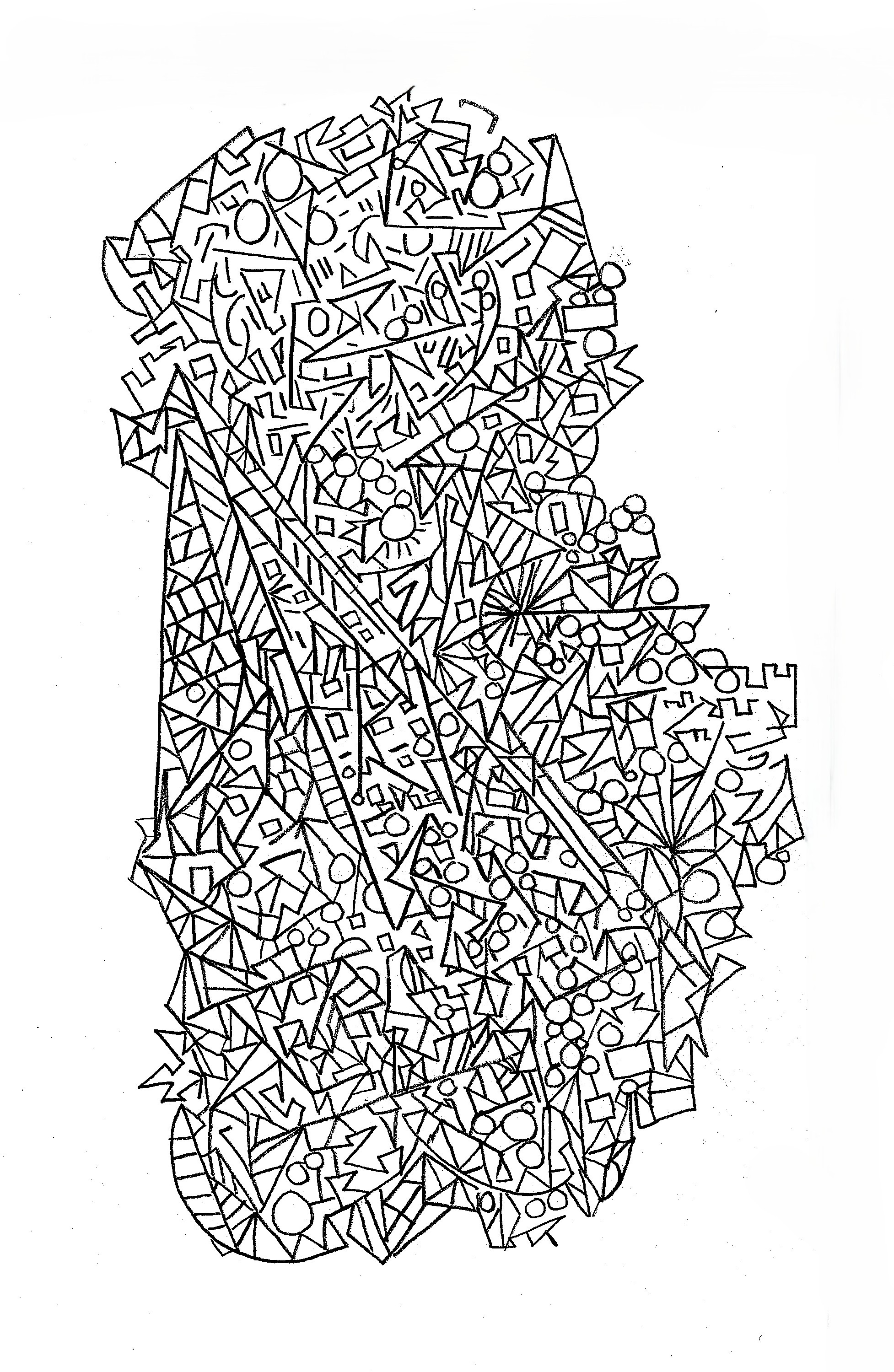
Language itself does possess a material life. Concrete and visual poetry reveal this. Poetry has the potential to draw from those of us making it and equally those consuming poems a host of unexpected sensibilities and knowledge. Ordinary, utilitarian language is there for a simple purpose: Please pass the salt, would you pick up the mail, etc. Poetry does something else, alongside recapturing our humanity.
AP I am interested in the political implications of that question. Capitalist language often seeks to stabilize things by giving them exchangeable names: labor becomes a “resource,” people become “human capital,” attention becomes a commodity, time becomes productivity. Your poetry repeatedly makes words unstable again. Could poetic language therefore be understood as a practice of de-reification — a way of returning movement, ambiguity, and sensuous particularity to things that social language has frozen into categories?
Some corporate language readily devolves into a satire on itself. Silly little phrases and deliberate substitutions of a phrase or word for another word comprise thinly veiled attempts to hide acts of abuse. “Human capital” is such a phrase. You offer the possibility that poetic language can return the fluidity and potency of precision and reality to language, refusing to “fall for” substitution that seeks to disguise or hide behavior that should not be sustained.
AP At the same time, your poetry does not seem to retreat from the contemporary world into abstraction. Political and sociological realities enter the work directly. You have described some of your recent poems as allowing connections among perceptions and “political and sociological realities.” How do you think poetry can remain politically alert without reducing itself to political statement? Where, for you, is the boundary between poetry that thinks politically and poetry that merely illustrates an ideology?
I suspect that the most potently politically alert poetry must reveal, as does the fabulous poem by Gwendolyn Brooks “We Real Cool,” such facets of reality as mortality, danger, and consequences in defiant youth. Brooks does not preach. She shows.
There is richness in philosophical study and reflection, political and sociological realities surround us, and we are part of them. The challenge with poetry that treats the art as a vehicle, either for protest, or for worship, is that it tends to be thin on language and technique and thick with message that cannot carry itself. Effective revelation of anything depends on much more than the desire to get a belief across to others.
AP Your work frequently brings the body, perception, movement, sound, and environment into the same field. This makes me think of Donna Haraway’s critique of human exceptionalism and her insistence on relational, multispecies forms of existence. Do you think of the poem as a site where the boundary between human interiority and the surrounding world becomes porous?
Interesting that you should mention the topic of the body and related perceptual issues as they may relate to poetry. I am part of a panel for a proposed conference presentation in 2027 on the body and embodiment in poetry. Oddly, one recent poem of mine states “I am not this body,” taking an opposite perspective, and yet so much of my work recognizes embodiment as a guiding reality.
One major point is that we as humans are only part of this world, not its selfish little centers. We do the planet and ourselves a disservice by fantasizing ourselves as in charge of the earth. The poem as a site for acknowledging and even embracing relational, multispecies forms of existence is important to consciousness, regardless of how our subject matter may emerge, veer, and transform. Haraway’s also addressing of masculinized versions of primate study becomes vividly relevant to this perspective as well.
AP There is also something strikingly ecological about your attention to particulars — not necessarily “nature poetry” in the conventional sense, but a refusal to treat the world as a passive background for human consciousness. Could poetry offer a form of attention in which nonhuman things cease to function merely as scenery, metaphor, or resource? And does such attention have political consequences in a culture organized around extraction?
I would cite here the glorious and well-structured poetry of Marc Vincenz, who takes ecological awareness in poetry to its highest level. Similarly, poetry rooted in nature and taking that to its rightful place in our living, as the very popular Mary Oliver did in her lifetime, is humbling. The form of attention to particulars in my own work may call to mind the fact that human life is lived within and of a space in which we evolve. I have become more keenly aware of nature in recent years, and I believe I have much more to learn about how this might guide me in my poetic progression.
AP Your use of inherited forms is especially interesting in this context. A ghazal, haibun, pantoum, or duplex carries with it a history, but you transform the form through contemporary English and contemporary experience. Jacques Rancière has written about the redistribution of the sensible — the reorganization of what can be perceived, heard, and said within a given social order. Do you think transforming an inherited poetic form can redistribute the sensible in this sense? Can formal innovation alter what becomes perceptible?
Inherited forms may be transformed immediately upon their use by someone in a different time and place from when a form originated. Each form carries with it a history, then acts as a prompt within a new context of time and place. Let’s take the haibun form as an example. The original Japanese form found in the anthology of Japanese poetry From the Country of Eight Islands edited and translated by Hiroaki Sato and Burton Watson is beautiful and instructive. Early on in my writing, I was drawn to the flexible and ingeniously freeing way in which John Ashbery composed each passage and followed that prose passage with a single-line haiku of indeterminate length. I felt compelled to try to write one of these and have never stopped. I labeled what I was doing “American Haibun,” and have continued to find the form sterling for more reasons than I can count. Rather than being constrained to a form founded primarily in nature, I could begin anywhere and go from there into the mysterious realm of what any given passage spawns.
Likewise, the duplex form developed by Jericho Brown somewhat recently attracted me, and I have written several poems employing this style. One notable feature of this form is that I find it pulls from me magnetically rather shockingly unexpected truths.
Contemporary English, like many other current languages, affords a way of treating such experience through the sound of words, the syntax, and ways of turning any existing patterns upside down. The poet can take up the mantle provided by any of our predecessors in writing and advance as we see fit through both the givens and newly discovered elements in life.
AP You have described Gertrude Stein as “fundamentally important” to you “both literarily and personally,” and have called her “one true knockout,” praising the “integrity and purity of her independent mind,” her fluency in language, and her “wholly unforced” originality. Stein’s writing famously disrupts the hierarchy between meaning and repetition, between information and linguistic event. What remains politically alive in Stein for you today? Is there something in her treatment of repetition and language that still resists the capitalist demand for novelty, efficiency, and immediately recognizable meaning?
Gertrude Stein owned and enacted her life in wholly unconventional ways that seem highly natural to me. I suspect that she barely noticed how different she seemed to others. She thought and felt and acted according to her intelligence, interests, and responsibilities and thereby shaped a reality that people have admired ever since. Far from a mere repetition machine she applied that practice to demonstrate transformed meaning on various hearings of “the same” words.
Stein further provided a glorious example of living one’s life, taking charge of that life, and creating one’s work apart from the strictures and taut lanes of what other people were doing, thinking, insisting upon for the collective comfort. To me, the whole of what Stein was and remains sets the stage for glorious freedom that I have emulated myself. Stylistically, Stein found her truest stride in such works as Tender Buttons, a remarkable achievement in innovation. Such works as Stanzas in Meditation are much more difficult than that, yet a certain reward comes from reading every stitch of the book. The Autobiography of Alice B. Toklas represents a hugely entertaining and revealing read. I will never forget hearing Stein’s voice for the first time on a recording I found pre-Internet days and how much her distinctive confidence came through.
AP Your collaborations are another important dimension of your practice. Collaboration fundamentally complicates the mythology of the solitary author. It raises the question of whether a poem can have a singular owner at all. Marx famously described social production as collective even when its products are privately appropriated. Do you think collaborative poetry reveals something that solitary lyric poetry tends to conceal about the social production of language?
Collaboration has been and continues to be important to my practice, but as you suggest, it is vastly different from my individual oeuvre. Frankly, I perceive collaboration as an experience that can teach a creator a great deal. Products in art, just like products in manufacturing, require more than one mind working for the good of the whole. Interestingly to me, at least, when I have collaborated, my art or writing partner and I have not separated out each person’s “part.” We do not sign our sections separately. Just so, a system differs from a collection of parts, more properly called an “aggregate.” An aggregate is not of interest to me if a pair or group of us is collaborating.
A great deal of humility comes to bear on the individual collaborating. My daily work with Douglas Barbour over a 20-year period, creating a lengthy work called Continuations, has two books brought out by the University of Alberta Press in Canada: Continuations and Continuations II. We wrote much more than that. We created a succession of six-line stanzas continuing into sections. Each of the books includes multiple numbered sections. The work there is intended to be smooth and not jarringly separate at any point. That work is singularly satisfying to me. I have collaborated in visual poetry with the remarkable K.S. Ernst, and the pioneering John M. Bennett, always learning from the experience.
AP I would like to push this further: if language itself is inherited collectively — no poet invents the language in which they write — then perhaps every poem is already a form of collaboration with innumerable absent speakers. Does this change the way you understand authorship? Where does the individual poet actually begin and end?
You are absolutely right. Authorship means taking part in a relay race, receiving the baton from one person, then working from there. I am reminded of the brilliant poet and playwright Javant Biarujia, my dear friend from the State of Victoria in Australia, who created his own language and recently produced his comprehensive dictionary of words in his invented language. Now that’s a creative act!
AP Your title Permission to Relax is particularly intriguing in relation to the contemporary regime of productivity. “Relaxation” sounds innocent, even intimate, but in a neoliberal culture it can also become another productivity technique: we are encouraged to rest so that we can return to work more efficiently. What happens to “relaxation” when it ceases to serve productivity? Could poetry create a genuinely nonproductive time — a form of attention that escapes the demand to produce measurable results?
I have been called a “produce-aholic,” constantly doing. I mention this because current spiritual practice in which I am engaged is intended to free me from urges that ultimately need to be placed in perspective. In a culture of production, one is expected to “do” all the time, to perform all the time, and rest as a kind of fueling act to maintain such propulsion. Due to personality and DNA, I am fairly sure that I need very little prompting from anyone to produce. As a child, I practiced on the flute for six hours each day, totally unprompted. I am the way I am because I like to work that way. I don’t wish to be naïve and think that it’s only a personal preference. I recognize the culture that I’ve lived in all my life.
The title of the book you reference was created in a period of painful loss for me. Grief takes its toll. The concept of relaxation suggested by that book’s title was frankly an impossibility. One does not recover from loss. One takes it in and changes, ultimately adapting. Although many people suspected that the title might have meant stepping back from work, it did not refer to that.
AP Marx’s distinction between use-value and exchange-value seems unexpectedly relevant to poetry. A poem may have almost no obvious practical use and yet possess enormous experiential, affective, or intellectual force. Do you think poetry protects a space in which value can exist without being immediately translated into utility or exchange? Or has even this apparent uselessness become another cultural commodity?
The commodification of practically everything around us poses a massive problem. I see an alternative currency at work with poetry. There are streams of people doing different things, and there is a regrettable sense of hierarchy that has gone on for decades here. University writing programs, while exposing students to valuable writing and practice, have simultaneously in some cases taken advantage of students’ potential independence.
There’s a perpetual stranglehold on the highest rated prizes in poetry and other writing in the United States. A handful of presses are considered, and it would appear, at least, that other presses appear not to “count,” regardless of the quality of the work they publish.
Poetry is not free of commodification. Some publishing and university programs control the currency. There seems to me a recent surge of commodification in the form of contests, workshops, and all sorts of monetized models emerging. While not bad in themselves, this pattern risks an imitative approach to creating, one that defies a better and purer independence.
AP Contemporary digital culture has intensified the conversion of language into data. Words are increasingly counted, ranked, indexed, predicted, optimized, and processed computationally. Your poetry often insists upon precisely those aspects of language that resist such reduction: ambiguity, acoustic resonance, accident, excess, discontinuity. Do you think experimental poetry has acquired a new political significance in the age of algorithmic language? What can a poem do that a system trained to predict language cannot?
I think with a smidge of humor at the noun “content” when I read of content providers for blogs and articles online. Filling space versus presenting value means we can surely do better.
Experimental poetry has the power to achieve a great deal. It is important, though, to recognize that anything new risks seeming ugly to people accustomed to something more familiar. Stein and Picasso both pointed this out. Also important is that George Ives, the father of composer Charles Ives, guided his son to facilitate his ability to tolerate dissonance in music by requiring his listening to music in different musical keys simultaneously to expand the musical capacity.
With this in mind, I would assert that a great poem has the power to change people and perceptions by opening the way for enormously beautiful realizations. Only language that performs its potential work unexpectedly and wonderfully can be part of this achievement. Impoverished batches of syllables won’t be enough to gain traction. Batching junk and hoping for the best won’t achieve anything. Careful examination of word choices and word invention offer hope and elevate human experience.
AP The question becomes even more complicated with generative artificial intelligence. If a machine can produce grammatically sophisticated and aesthetically convincing language by learning from an enormous archive of human texts, what happens to our traditional ideas of originality, authorship, intention, and voice? Does AI expose the fact that language has always been collective and recombinatory, or does something essential remain outside computational generation?
One can “trick” a system to arrange and produce language. One can train an agent to perform as prescribed. I recognize that it is difficult to compete against an AI-based chess competitor. Likewise, I suppose one must accept that it would be possible, as well, to create something powerful in language and poetry via AI. That said, if one is a writer, the vibrant experience of finding, making, and being changed by a poem remains like no other. Should AI continue to be refined, that feature might be used to enhance a human-guided hand in refining what one has begun.
I’m sure you’ve seen all kinds of calls for submission in poetry in which one checks the box indicating that no AI was used to create the poem. There may be some way to utilize whatever tools may become available to enhance what we do, but I would not at the moment advocate relegating poetry to an artificial machine. By the way, given that there is no such thing as a purely AI-driven entity, we must remember that there is human guidance behind all artificial intelligence. It does not birth itself right now.
AP Your poetry seems deeply committed to possibility: the possibility that a word might mean otherwise, that two distant things might suddenly become adjacent, that a formal constraint might produce an unexpected freedom. Ernst Bloch understood the present as unfinished, containing a “Not-Yet” — unrealized possibilities that have not yet become fully manifest. Do you think poetry can preserve forms of possibility that existing social language has not yet learned how to articulate?
Oh, absolutely, yes I do. Possibilities are all around us. The not-yet facet of these infuses hope for all of us. Each moment we live is rife with surprises. I revel in such excitement.
AP There is a political question hidden inside that idea. Capitalism often presents itself as having no outside: its categories of value, labor, productivity, property, and exchange appear simply as the reality of reality. Could experimental poetry function as a small-scale laboratory for imagining forms of relation that cannot yet be fully recognized by the dominant order? Or would you resist giving poetry such a utopian task?
Poetry can take on any task. The only caveat I have here is that the “understanders” of complex, adventurous poetry remain few, despite the hordes of people who want to become the next Shakespeare! Poetry is hard work, and I feel certain that it could readily serve as a laboratory that splinters any dominant order.
AP Finally, I would like to return to the question of what poetry does in a life. You have spoken about poetry as a sustained practice through which you have come to know yourself, to grow, and to remain attentive to the world around you. This formulation seems to move ethics away from a system of rules and toward a practice of relation. Could poetry itself be understood as an ethical technology — a way of changing how one attends to other people, other forms of life, and the world? And if so, what kind of person does the practice of poetry make possible?
My life was made for poetry, and poetry was made for my life. It is a beautiful privilege, if an unremunerative one! I’ve had to lead what I term a “double life” given my commitment to independence in all areas of my life, notably financial. I have worked very hard always to manage, thereby watching, the multiple “burners” I keep cooking in my life, achieving in multiple realms. I have deep affection for the people in my life, and I devote considerable time to those I love, while keeping conscious of financial realities that allow me to pursue my writing and now my visual art, alongside visual poetry. Poetry has required me to design a sustained way to live that keeps me in charge while opening my spirit and my intellect and my physical body to experience that is mutually enhancing with the art.
I used to wonder (and I still wonder) what people who do not write poetry actually do. That hilarious question is very real to me, but I continue to ponder that. Life is for poetry, and poetry is what life is about. It’s a kind of spiritual and realistic framing of all I have known and all I know now. Poetry makes learning a continuing reality.
Thanks, Aleksey, for these extremely good questions!