AP You have taught for more than forty years at LaGuardia, a CUNY community college. How has that student body changed your sense of what “difficult” poetry is, and who it is for?
My own experience as a reader has formed, sometimes changed my sense of what difficult poetry is. As a first-year grad student, while writing an MA thesis on Robert Lowell, I found John Ashbery’s poetry maddeningly difficult. Considerably later, as an assistant professor, Mei-mei Berssenbrugge’s work vexed me, and then didn’t, and after that, even though I had found a way to read Ashbery’s most fractured poems in The Tennis Court Oath (Wesleyan UP, 1962), I couldn’t manage for several years to make much of the disjunctions of the Language Poets. Then something clicked. The weirdest thing, though, is that when I was working on my Selected Poems & Poetic Series in 2014 and 2015, I looked at a few poems in After Taxes (Marsh Hawk P, 2004), and I had trouble following where they were going and why they might be going there. I barely remembered having written them.
I’m in my 46th year at LaGuardia. The student body, the demographics of which is ever shifting, has not particularly changed my sense of what “difficult” poetry is. At times, the cause of a student’s specific difficulty rooted in context will be edifying. For example, a student whose primary language was Spanish and who was probably a devout Christian insisted that John Donne’s “The Flea” was a sincere evocation of the sanctity of marriage. I tried very hard to get her to see the possibility of an ironic interpretation and failed, and she maintained that if I understood Spanish, she could convince me of her reading. (This was an era before Google Translate.) Even as a college student, I knew that poetry I would consider straightforward can be challenging for different people. For example, I remember “teaching” Robert Frost’s poetry to my college roommate who was very proficient in economics and math.
Against the claim that “difficult” poetry shuts most people out, I would ask: shouldn’t everyone have the benefit of absorbing good “difficult” poetry through a little bit of instruction and group exploration, if they’re open to it? In his essays, Charles Bernstein has provided a great deal of strong evidence for an affirmative answer to this question. All kinds of poetry should be a resource to everyone, and everyone should have access to educational opportunities that could enable them to engage with diverse literary texts. In my Writing through Literature and Introduction to Poetry courses, I usually sprinkle in some difficult poems. In recent years, I’ve taught work by such poets as Sheila E. Murphy, Ashbery, John Yau, Natsuko Hirata, David Shapiro, Harryette Mullen, and Mark Young alongside what many in poetry communities would find relatively accessible poems. In a U.S. context, it is especially useful to include “difficult” texts by poets of color, because some readers may have a limited view of “identity” that needs to be challenged. John Yau, for example, used to note that the mainstream Asian-American poetic community would exclude or marginalize him for the alleged difficulties of his work, though, recently, this problem seems to have disappeared.
AP You have written a book on teaching college students to interpret poetry. Can learning to read Ashbery be a political skill, a way of not mistaking the “clarity” of official language for truth?
Some of my students have an instant rapport with the multiple disjunctions of a short Ashbery poem—say, one of the 16-liners from Shadow Train (Penguin, 1981), because it is familiar to them from videos and Web surfing. While these leaps are one strategy of consumer capitalism, they can also be placed in the service of defamiliarization. Your question focuses on Ashbery’s parodying of official language, and learning to read this aspect of his work can indeed be this form of political skill.
AP You describe yourself as a professor who “moonlights” as an abstract painter, while also writing poetry and criticism. Does working across these fields resist the logic of professionalisation and the market, or is it simply a practical matter of how your life is organised?
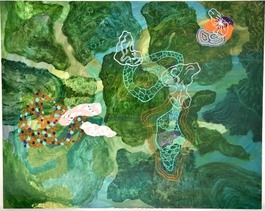
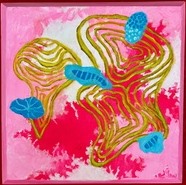
I have made a living as a professor, and so it has been incumbent on me to write criticism, and I have enjoyed doing so. Since the age of 14, I have had a strong desire to write poetry, and at 29, I began to feel impelled to paint and have continued to do that. My paintings are usually on my poetry book covers. Working across the fields may resist the logic of professionalization and the market because I am not specializing exclusively in one area. Also, I don’t try either to tailor my writing and art to current trends in those fields or to avoid the trends. I do what I feel drawn to do.
AP In “Yinglish Strophes,” Yiddish-inflected English syntax becomes a way to speak about immigration and intergenerational differences. Do you see a link to the Jewish left tradition, in which Yiddish was the language of much of the labour movement and not only of nostalgia?
Yinglish and Yiddish speakers I knew personally, members of my family now long gone, were not politically involved. But your observation is historically accurate, and that reference can enrich a reader’s sense of what is going on in some of the poems.
AP You describe the syntax in “Yinglish Strophes” as an approximation (and often an exaggeration) of Yiddish-inflected English. Does such stylisation risk becoming a folkloric commodity? How do you tell preserving a language from aestheticising it?
I would say that my sentences frequently deviate from the actual Yinglish syntax that I’ve heard rather than exaggerate them. For example, no Yinglish speaker would say: “Marriage optimum// a beautiful soul to/ with” (“Yinglish Strophes 31,” Or Current Resident [Marsh Hawk P, 2025, p. 46]). There could certainly be a noun/adjective sequence, but I doubt that would be followed by an article/adjective/preposition/preposition sequence with no verb or verbal in the entire “sentence.” I was striving for maximum strain of syntax.
If some readers are inclined to frame the “Yinglish Strophes” as a folkloric commodity, they will do it, regardless of my intentions. I’m not trying to preserve Yinglish, though I think it’s a valid goal that others are pursuing. I’m trying to make non-normative syntax permit interesting and diverse possibilities of signification while the poems consider, directly or indirectly, social and psychological topoi. I still think that trying to enhance the poetic “imagination” in Wallace Stevens’s sense is a worthwhile endeavor, and that may be one way to do it. (For a compelling account of the value of the imagination, figured as poiesis, see Paul A. Bové’s book, Love’s Shadow [Harvard UP, 2021]. As a young assistant professor, he was my much appreciated mentor in graduate school, and, for me, this recent book is, thus far, his crowning achievement.)
AP Yiddish-inflected English, like other forms of immigrant speech, has often been judged against the norms of standard literary English. Can “Yinglish” be understood as a politics of error, a refusal of the prestigious literary register?
I don’t reject or prioritize the norms of standard literary English or alternative “Englishes.” Both can be generative; it depends what one does with each. The differences between “errors” in “Yinglish” speech/writing and standard versions of syntax/idiom have the potential to produce poiesis.
AP The title “Dusk Bowl Intimacies” seems to echo the Dust Bowl, and you describe the series as registering both displacements and quests for individual security. How do displacement, economic precarity and intimacy relate to one another in this series?
Yes, the title echoes the dust bowl displacements in the U.S. in the thirties, and the substitution of “dusk” implies that, if there is a single speaker (and I would maintain that, even within the individual “I” are numerous “others,” she is advanced in years—significantly more than I am now, and I’m an early septuagenarian. In most of these poems, “individual security” involves intimate relationships with family and significant others as much as or more than financial security. Sometimes, the speaker of one of these poems mentions “investments” and “equities,” so she is not necessarily experiencing economic precarity. But perhaps some of the poems suggest that even those who cannot objectively be said to be experiencing such difficulties may have a kind of PTSD from earlier national or global financial panics or recessions or from imbibing their parents’ neurotic insecurities that no “nest egg” is ever enough, and fading mental or physical health is a displacement that can engender a sense of insecurity. “Intimacy” relates to such anxiety because the speaker does not keep her vulnerability to herself; she voices it, I suppose, to whoever will listen.
Apart from the figure’s economic precarity, various “Dusk Bowl Intimacies” and poems some other series, such as the “Goads,” rather indirectly and often humorously explore the problems of a spiritual condition: “Everyone should own what can never be taken away. As we have no babies to medicate, I mostly think about me” (“Dusk Bowl Intimacies 3,” Selected Poems & Poetic Series [Marsh Hawk P, 2016, p. 176]). As a Nichiren Shoshu Buddhist, but one who, does not risk distortion by putting theological constructs directly into his poetry, I believe that both the kind of excessive attachment to one’s desires/fears about material conditions and others’ alleged mistreatment of one and a posture of indifference to the world’s workings are causes for continual suffering and overall unhappiness.

AP You have said that some people see particular kinds of politicising of poetry as the most authentic, useful avant-garde gestures, and that you sometimes find the results intellectually and aesthetically compelling. Where do you draw the line between a politically convincing poem and a slogan in verse packaging?
I acknowledge that some poetry that is mostly “a slogan in verse packaging” has roused people to political action in situations where a critical mass opposing oppression had a laudable liberatory effect. But then again, “slogans in verse packaging” have also had the effect of promoting the rule of demagogues.
A politically unconvincing poem manifests tropes, images, narrative gestures, and abstract formulations that I have seen over and over. Sometimes such a poem is also marred by a rage, venting or an ad hominen attack on an enemy that is not supported by at least a hint of specific social analysis, or a kind of general melioristic (and frequently moralistic) exhortation that does not take account of how it could be implemented and is desperately situated to be read as “sincere.”
Poetry that seems to denounce any behavior, activity, aesthetic mode, or perception that cannot be thoroughly useful to progressive political change as reactionary (or worse) is, frankly, counterproductive, even if the impulse behind it is admirable or if that impulse is conditioned by the poet and his/her/their people’s tremendous suffering. Referring in all likelihood to post-World War II Poland and Eastern Europe in general, Wisława Szymborska in “Children of Our Age” offers a wild dose of hyperbole that can somehow be supported: “It is a political age….// Whether you like it or not,/ your genes have a political past,/ your skin a political cast,/ your eyes a political slant….// Apolitical poems are also political….” (View with a Grain of Sand: Selected Poems, translated by Stanislaw Barańcak and Claire Cavanaugh, Harcourt Brace and Company, 1993, p. 149). Szymborska, I think, is acknowledging the cognitive and affective force of the contextualization of everything, including biological data and “apolitical” poetry, as political, given the events of the twentieth century, while she is still ruing this coercive situation and implicitly calling for possibilities of alternative thematic framing that I find in most of her poetry in various translated collections. A doctrinaire poet/critic would find most of her work insufficiently attuned to political “necessities.” Political poetry that historicizes aptly, that includes sufficient interpretive nuance if it generalies, and that tends to treat language as more than a conduit for propositions has the best chance to be politically convincing.
AP Zeugma takes its title from the yoking of disparate things by a single word, and Patricia Carlin’s Foreword reads the book as reflecting “the fragmented, unstable, and confusing contemporary scene.” Can that yoking also be read as a model of contemporary capitalism, in which incompatible things are bound together by one market? What, in your view, holds the present together?
Yes. It is a model of this dimension of contemporary multinational capitalism, yet it also provides opportunities for critique of that hegemony and for imaginative play that engenders promising alternative actions and understandings.
Far be it from me to pontificate on what holds the present together.
AP The “sonnina,” your hybrid of the sonnet and the sestina, combines a short lyric form with one in which end-words are compelled to return. Is this formal play, or a working metaphor for what inevitably recurs in our political situation?
A few days ago, I attended a workshop on the Oulipo technique of lipogram at LaGuardia’s National Day on Writing celebration. In his introduction to the session, my colleague Noam Scheindlin, a fine poet and a scholar in that area, underscored Georges Perec’s contention that constraints in the production of literary texts force the mind to go beyond its usual linguistic (and, arguably, conceptual) limitations. I agree. So the sonnina is formal play and, in the lyrics of the Doors’ Jim Morrison, an attempt to “break on through to the other side.” Then again, “Pledge (Sonnina)” makes direct references to recurrent problems in U.S. political life: the opening line is “We pledge allegiance to the stars,” the poem goes on to speak of “election/ results hold[ing or not holding] up in the court/ of revolving novelties, and the last sentence reads, “Divided,/ we court/ screened enervations, starry victories—divided// from our fluctuations, from purple states/ untallied, from suspended states” (Zeugma 14). And similar political allusions also appear in other “Soninas.” I didn’t initially think of this hybrid form as a working metaphor for political recurrence when I devised it, but, as we know, the unconscious works overtime.
AP You say that some poems in Zeugma refer, sometimes obliquely, to extremism in the Republican Party, and that the opening poem reflects on the pandemic. How do you write about such events so that the poem neither turns into journalism nor retreats into a pose of standing above the fray?
“Giant Whippersnapper” begins: “The Chief exec snubbed his eviction/ notice” (Zeugma 79). It’s pretty clear that this refers to what occurred between November, 2020 and January 20, 2021, but it’s hardly journalistic discourse nor is it evidence of detachment. There’s a difference, I hope, between “standing above the fray” and ironic critique: “Self efface ment/ untried. Grunting for an advance/ on loyalties.” In Hedge Fund Certainty (Meritage P, 2019), there is a whole series devoted to this subject called “Subprime Mortgage Bargain Lot.” The humor and critique in that series frequently comes from Bakhtinian double-voiced discourse. My language mouths the discourse of a particular demagogue; it can exaggerate what is already exaggerated and marginally coherent.
AP Critics have long argued over whether a broken or fractured syntax is itself political. Do you think it can carry political content, or is that a self-deception of the avant-garde that changes nothing outside the journal?
Broken or fractured syntax and coherent standard English syntax and everything in between can carry political content and sometimes one of them does not or doesn’t do so in an interesting way and standard syntax inherently ideologically bankrupt or thoroughly coercive. I think it’s self-deception if an avant-garde poet thinks that fractured syntax is inherently political. Certainly, standard syntax has been a tool of oppression; that doesn’t mean that it distorts “reality” or oppressive power relations any more or less than disrupted syntax just because a grammatical subject that has an active verb is superior in the hierarchy to the object in the sentence or because the subject with a passive verb is inferior to the object of the preposition after the verb.
AP Ashbery, the subject of your dissertation, is sometimes characterised as an apolitical poet, partly because of his resistance to direct political statement. Do you find ways of reading him politically, through sexuality, class or the destabilisation of certainty, or would such a reading impose a framework the poems resist?
My 1981 doctoral dissertation at Columbia University was apparently the third one on Ashbery. The first two were by David Shapiro, author of the very useful but neglected first book (Columbia UP, 1979) on him that was a revision of his Columbia dissertation, and Donald Revell, whose work I could not have read at the time. Derrida was in the air because of recently translated texts from the 60s and the advocacy of J. Hillis Miller, Barbara Johnson, and Paul de Man. In important respects, my dissertation follows Shapiro’s fundamental insight that Ashbery’s destabilization of certainty was the “central” “decentering” dynamic, and I depart from his notion that the poet discloses “the meaning of meaninglessness” or that his surreal scrambling of cause/effect relations signifies “the breakdown of causality in contemporary thought and art” (175). (I don’t believe that cause and effect can “break down,” even if it is not represented “realistically.”) The only contribution, if any, that I made in that dissertation was to read some poems more closely and less impressionistically than Shapiro and a handful of others had and to speak directly about a continual movement in exemplary poems between presentation/assertion and demystification/dismantling of a concept/stance.
Then, for Shapiro and me in the late 70s and early 80s, as well as David Lehman and some later critics, Ashbery does not ultimately posit any ideology or philosophical position. (At this point, I don’t think that main abstraction about presentation and demystification in my dissertation or my sense that Ashbery’s work does not valorize any concept or attitude, which I referred to in the title of a 1984 article as “Ashbery’s Comic Thrust” [Twentieth Century Literature, vol. 30, no. 1, pp. 1-14], tell anything like the whole “story” of his oeuvre.) One statement in Shapiro’s book may be said to link Ashbery’s work with the political: “The central metaphysical-moral component in Ashbery’s verse is its deadly withdrawal of the transcendental term and insistence on individual liberty…. The poem is a difficulty, a resistance, and a critique” (12). This brings us back to arguments in the early 80s about whether Derridean deconstruction as an undoing of western metaphysics without the positing of a set of political philosophical tenets to replace it can be useful for political action or whether it discourages any attempt to work toward progressive change. Unlike Ashbery, Derrida responded to those who regarded deconstruction as politically deleterious; he wrote about the nuclear crisis, apartheid, animal rights, and Marx in the last 20 years of his life. Pro-Derrida writers I’ve read, including some feminist post-structuralists like Gayatri Chakravorty Spivak, also a Marxist, and queer theorists, have made the argument that to deconstruct the western metaphysical tradition is to challenge the basis for unequal power relations within capitalism, patriarchy, the regime of heteronormativity, etc. The gradual acceptance of deconstruction as part of a “feminist” or “marxist” or “cultural studies” or “postcolonial studies” toolkit in the U.S. academy suggests to me that this argument has prevailed, whereas the “logical” “conclusion” of a mise en abîme, Derridean thought as infinite regress, does not stand in the way of the deployment of political deconstruction. If that applies to Derrida, it can apply to Ashbery, even without Queer Theory, which I’ll get to soon. If you parody or undermine dominant discourses, part of the effect has to be a kind of opposition, if only partial, to what those discourses are advertising. Think, for example, of “‘They Dream Only of America’”: “They dream only of America/ To be lost among the thirteen million pillars of grass” (The Tennis Court Oath, 13). And “Decoy” begins with the “self-evident” opening independent clause of the U.S. Declaration of Independence, only to veer right into the idea “That ostracism, both political and moral, has/ Its place in the twentieth-century scheme of things” (The Double Dream of Spring, Ecco Press, 1970, p. 31). Can one not associate this swerve with the idea that the United States has not lived up to claims about equality put forth in the Declaration?
If we take his interview statements at face value, and having spent a little time with the poet and various others at three or four dinner tables, I do, Ashbery himself would poo-poo a reading of himself as a political poet. He once called himself a love poet, and he has valorized escapism by suggesting that since life is difficult, there should be more of it. When Ashbery and Stephen Paul Miller were once conversing, the latter made fun of the former for finding an isormorphism between “Self-Portrait in a Convex Mirror” and the Watergate Affair. (This was published in The Seventies Now: Culture as Surveillance [Duke UP, 1999], though it appeared in a journal a few years earlier). He told Miller, “You’ll get yours. Nixon was a great President.” I think (hope?) he was kidding about his assessment of Nixon.
The earliest argument about the politicization of Ashbery’s poetry through the lens of what is now called queer theory is John Shoptaw’s On the Outside Looking Out (Harvard UP, 1994). Shoptaw convincingly addresses the context of the pre-Stonewall closet in his account of the play of concealment and disclosure in Ashbery’s “homotextual poetics.” David Shapiro told me that the poet himself expressed displeasure at Shoptaw’s project. I have not kept up with recent Ashbery scholarship, but a Google search has clarified, that since that book, there have been many queer theory analyses of Ashbery’s work—for example, several on the features of “camp” in the poetry.
AP You have written extensively in collaboration, for example with Maya Diablo Mason (Autopsy Turvy and A Pageant for Every Addiction) and Tom Beckett (Former Sestinas). How does co-authorship undermine the idea of ownership over a poetic voice?
Yes, collaborative poetry can challenge univocality and individual author-ity. I’m going to refer to the collaboration of two poets, which I’ve experienced, but what I have to say could equally apply to larger numbers of poets collaborating. There are several reasons why it may not: dominant features of the poets’ styles are already extremely similar and they are not trying to depart from those styles (whereas the less prominent stylistic features do not appear), the poets may have chosen to do a persona poem and they are adept at managing a particular limited voice, they are striving for ideological or thematic unity, or one poet abandons their own “voice(s)” and is intent on conforming to the other’s. Naturally, there are also reasons why polyphony can be achieved in this situation: both poets prioritize the potential multiplicity of voices within a posited speaking subject (the “I” composed of others heard and absorbed) and/or a multiplicity of voices (that they have heard and absorbed), a constraint chosen as what Edward W. Said called a “beginning intention” is daunting enough to encourage a departure from ordinary syntax and/or polyvocality through linguistic defamiliarization, as well as both participants’ usual poetic habits, and the line-by-line negotiation after the two poets produce a first draft (often through alternating passages) involving processes of one-way capitulation, compromise, elimination, and replacement with new phrases engenders the manifestation of multiple differences of intention within the whole text. (I’ve decided not to talk about my collaborations with Mason and Beckett, because I would not be able to represent their perspectives by myself.)
AP You write poems, criticism and abstract paintings. Abstract painting has historically been both a symbol of freedom and an object of the art market. Where do you see room for resistance here?
The political impact of Malevich’s suprematist canvases inside and outside of Russia cannot happen again with abstract art. It is much too late to be the same symbol of “freedom from” something that it was at one time, even if it involves a “freedom to” imagine. The Abstract Expressionists were used by the U.S. State Department to glorify 1950s U.S. capitalism, yet I don’t think that this fact or some of the overblown transcendental rhetoric, the metaphysical blather, of figures like Clyfford Still, is a reason to discount those artists’ work, as one can find psychological intensity and an absorbing play of colors, shapes, and textures in much of it. (I appreciate Joan Mitchell’s departure from that blather; she stated that her work reflected the emotion of her memory of a landscape, as opposed to an attempt to depict the landscape. Surely, this is preferably to Jackson Pollock’s macho “I am nature.”) As a grad student at Columbia, I attended Edward W. Said’s class on critical theory and read a good deal of his literary criticism, and one thing I admired about his attitude toward literature is that he could rigorously critique an author’s orientalism or racism and find value in their potent aesthetic accomplishments.
Your question is whether there is room for resistance in abstract painting in 2026. In the last month, I’ve gone thrice to an exhibition in a Chelsea, New York gallery of the work of Norman Lewis (1902-1979), a superb African-American painter who did not get his due during Abstract Expressionism’s heyday. Sometimes, Lewis’s canvases seem extremely abstract; at other times, there are abstracted yet recognizable human figures, as well as titles that provide worldly contexts. Your question pertains to abstract art that isn’t “hybrid” in that sense, such as Willem de Kooning’s notorious “Woman” series. Now for a common sense observation: individual colors, color relations, geometrical, biomorphic, and jagged shapes and contours, linear elements, and textures can all be read referentially by whoever (scholar/critic, artist, aficionado, patron, casual viewer) wants to do so, whether or not any intersubjective consensus is ever established. Using a title or public statement, an artist who appears to be creating an abstract work can insist on a political intention. And anyone else is free to agree or contest the contextualization. I’m persuaded that a Norman Lewis painting I’ve seen with abstracted Ku Klux Klan references conveys the horror of that historical context and also that this impact would not exist without his masterful deployment of abstract compositional strategies. In paintings where there are no discernible referential signs, I would be hard pressed to locate resistance, except to the notion in whatever sector of U.S. society during Lewis’s time believed that black artists should only engage in social realism. And that notion tells me nothing about how to think about my current reception of the work.
In short, the room for resistance in abstract painting is enabled by the ability of the perceiver to referentialize otherwise abstract elements and to convince others that his/her/their perception deserves consideration. While working on a painting, I don’t think about referential equivalents for anything in my composition. But after a canvas is done, I feel compelled (as a poet, I suppose) to title it, which isn’t usually easy. So I will often come up with something amusing and arbitrary, such as a partial quotation, or I will be reminded of a state or process by the interaction of the work’s elements and will happen on a title that relates to what I see. Nevertheless, in the second case, I don’t take my referentializing seriously and would not want it to mean much to someone looking at the painting.
AP If solidarity is the ability to say “we” without losing “I,” where is that “we” in your poetry, for instance in the verse play “Who My People Are”? And what would you say to a reader who needs not understanding but action?
“Who My People Are” is an three-way dialogue between someone who has lost her way and feels consistently vulnerable, a friend or relative who has empathy for her and is trying to help, and another who is exasperated with the neediness and bumbling of the first and the “do-gooder” attitude of the second. If there is an argument, it is unresolved; tension is not dissipated. I don’t think it can be accurately used as an allegory of political negotiation among divergent constituencies or of a desired enlargement of the scope of a progressive community in order to achieve a critical mass that will have the leverage to bring about enduring social change. If I’m wrong, I would be happy to learn how that might be.
Seemingly throughout history, poets have felt compelled to write “defenses of poetry.” What Ben Lerner identifies in the title of his monograph as The Hatred of Poetry (Farrar, Straus and Giroux, 2016) keeps clamoring in every generation. Some people, he argues, consider the standards for poetry so high (i.e. transcendence) that the actual results are bound to disappoint, and others, like Plato, condemn it as pernicious escapism. Of course, some negative critics habitually denounce contemporary poetry as woefully inferior to some “gold standard” based on past accomplishments. Some use a political lens in making this assessment.
Regarding the idea that someone might seek action and not understanding, it is important to be open to the possibility that one’s current understanding of the global political landscape may at any time have to make room for previously unseen variables that could shift one’s conception of what actions are desirable. Poetry combined with cultural criticism by Adrienne Rich, Audre Lorde, and Gloria Anzaldua, all prominent lesbian-feminist authors, provided a sense of various pressing issues facing women and those with intersectional oppressions and the need for particular kinds of resistance in the 70s and 80s, whereas the representation of gender power relations in 2026 must differ to some degree in the work of contemporary feminist poets such as Safiya Sinclair, Patricia Smith, Claudia Rankine, and Ada Limon, as well as transgender poets such as Trace Peterson, Amir Rabiyag, and Micha Cárdenas. Michel Foucault’s late formulation of problematization, which features the recognition that, throughout the historical configurations that he studied, solutions to problems have all posed other problems, might also prevent an individual for assuming that there is no need for further understanding.
Let’s say it’s understood that the biggest goals are the liberation of oppressed peoples, the eradication of significant income inequality, and a decisive ecological turnaround toward sustainability, and let’s say that “action” entails large, painstakingly orchestrated protests, boycotts of companies, other institutions, and investment in “rogue nations,” work stoppages, implementation of alternative structures for production of goods and services that stand outside traditional capitalist exchange, intense, coalitionally diverse communications with powerful multinational capitalist entities, enhanced, coordinated exercise of franchise in countries that don’t entirely want to squash it, or (as a last resort) violent revolution(s). And let’s suppose that the reader I am charged here with responding to believes that poetry should not only provide understanding that simultaneously encourages action (which much political poetry has) but should provide a blueprint for extensive action. I would have to answer that such a blueprint potentially comes from well-reasoned, logically ordered, highly specific texts that rely on lessons of what has worked and failed in political, social, and economic history to formulate available strategies and articulate untried possibilities or (if such can be found) dialogues among those with differing perspectives that cover this kind of terrain with ample thoroughness, but I am not confident that poetry possesses the discursive equipment to have the same effect. That being said, I have not done a thorough study of current ecopoetry that incorporates documentary techniques to foreground important aspects of ecological crises (or other political contexts), and so I am not going to write off that possibility. Going back more than a century, the emotional force of W.B. Yeats’s “Easter 1916” certainly inspired already committed and perhaps some less committed Irish to engage in the long struggle against the British, despite contemporary critics’ view that the poet’s nationalism was deeply conservative; nevertheless, it clearly did not provide a blueprint for long-term action. And did the vigorously troping pro-Bolshevik exhortation of Vladimir Mayakovsky’s 1917 “Our March,” “Pound the steps of rebellion into the squares!/ Raise higher the bank of proud heads!/ Spilling over in a second great flood,/ we’ll wash the cities of worlds” (Selected Poems, translated by James H. McGavran III, Northwestern UP, 2013) offer instructions for how specifically to “pound,” “raise,” and “wash”? I think not. Even modern epic poetry, such as William Carlos Williams’ Paterson (not to mention the right-wing Ezra Pound’s Cantos), can’t achieve the confluence of specificity and breadth of other writing/dialogue that I have mentioned.
Poetry can achieve salient political critique that engages the emotions and, as a synecdoche for more thorough examinations, the intellect. Here is an extreme formulation of what I take to be a particular viewpoint: The world is in peril of vanishing, and inequality among its inhabitants is overwhelming; therefore, in order to keep these things from worsening and ultimately, ending civilization as we know it, everything (including poetry) must always be put in the service of this struggle against the dire situation. Poetry possessing progressively political content can serve as emotional sustenance, yet poems (like many of Szymborska’s and nearly all of Ashbery’s, to go back to previous points in this exchange) that are not overtly political can provide other benefits, ones that, I hope, have been underscored during this exchange. What I said earlier about the relation between Nichiren Shoshu Buddhist tenets that I follow and poetic critique of particular self-sabotaging attitudes and behaviors underscores the idea that sometimes not so political focus on the individual rather than the collective can actually serve collective welfare. Not very political verse can also contribute psychological and cognitive refreshment to sociopolitical activists that strengthens their ability to work for social change and enables them to avoid succumbing to debilitating fatigue when their objectives’ horizon seems far away. Action must constantly be pursued on various fronts; perhaps both “easy” and “difficult” poetry can encourage such efforts in various, often indirect ways.